

If you’ve been out of school for years, are balancing a demanding job or simply don’t want to add months of test preparation to an already busy life, the GMAT exam can feel like a major barrier to your desired MBA.
The good news is that it isn’t always required.
Many business schools now offer GMAT waiver pathways for qualified applicants, giving experienced professionals with a strong application another way to demonstrate readiness for their MBA.
If that's you, here’s what you need to know before you apply.
What a GMAT MBA waiver means for business schools
The GMAT is a standardized test widely used in graduate business education, trusted by more than 7,700 programs and 2,400 business schools worldwide. It’s designed to showcase skills such as problem-solving, critical thinking and data analysis.
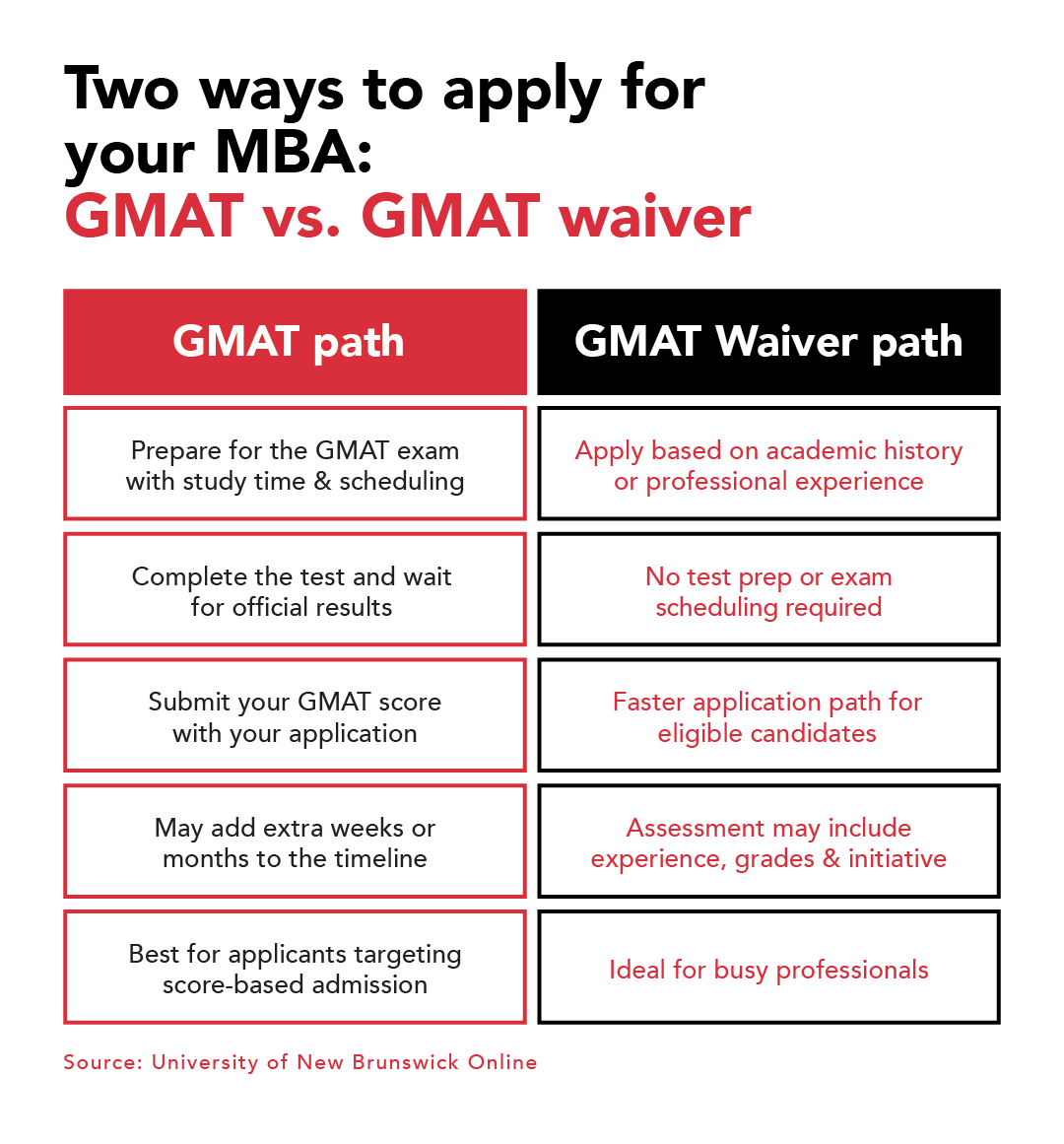
A GMAT waiver allows eligible applicants to apply to an MBA program without submitting a GMAT score. It gives business schools room to consider whether your professional record already demonstrates the skills they’re looking for.
In some cases, the admissions committee may make the waiver decision before you submit the full application.
In other cases, your waiver request is reviewed as part of your overall admissions file.
Regardless of the institution's policy, a GMAT waiver can reduce friction in the application process.
Why some Canadian Universities are moving beyond the GMAT exam
Many MBA applicants are managers, business analysts, entrepreneurs, consultants, specialists and working parents, and their value may be demonstrated over years of education and career progression rather than by a single test score.
A GMAT waiver can help business schools evaluate those candidates more holistically.
In addition to this, GMAT waivers are partly in response to changes in employer expectations.
GMAC’s 2025 Corporate Recruiters Survey found that 99% of employers trust graduate education institutions to prepare graduates for success. The same report highlighted problem-solving and strategic thinking as highly valued skills, with employers also anticipating a growing importance of AI tools, technology skills and data analysis.
In other words, the question isn’t always, “Can you perform well on the GMAT?” It may be, “Can you think strategically, communicate clearly, lead people, work across functions and make decisions in uncertain environments?”
For many experienced applicants, the answer is more visible in their careers than in their GMAT scores.
Common admissions requirements for MBA applicants seeking a GMAT-free path
Every school is different, so you should always review the admissions requirements for each MBA program you’re considering.
Still, many GMAT waiver application pathways ask for a combination of academic, professional and personal materials.
Common requirements may include:
- A bachelor's degree from a recognized institution
- A strong academic record
- Relevant diploma-to-degree progression, where applicable
- A resume showing career growth and leadership exposure
- Letters of reference
- A statement of intent or personal essay
- English language proficiency, if required
- An interview, in some cases
- A formal request for waiver approval
Your goal is to make the admissions committee feel confident that you can succeed without the GMAT score as a supporting data point. That means your application should be clear, complete and specific.
How work experience can outweigh a GMAT score
A GMAT score can signal academic readiness, but your career can show judgment, resilience, communication and leadership.
Strong waiver applicants often highlight:
- Promotions or expanded responsibilities
- People management or team leadership
- Revenue, operational or process improvements
- Cross-functional collaboration
- Budget ownership
- Strategic planning
- Client or stakeholder communication
- Industry expertise
This doesn’t mean every applicant needs a senior title. You may still be a strong candidate if you’re early in your career, but can demonstrate depth, initiative and a clear reason for pursuing an MBA.
Full-time MBA programs vs. flexible options when applying without GMAT
Getting into an MBA without a GMAT is only one part of the decision. You also need to choose a structure that fits your career stage, learning style and financial reality.
Full-time MBA programs can be a good fit if you want an immersive experience, access to in-person networking and a faster career pivot.
They may appeal to applicants who are willing to pause work or reduce professional commitments to focus on school.
Flexible, part-time or online MBA degree options may be better if you want to keep earning while studying.
They can be especially useful if your goal is to move upward within your current organization, apply new learning immediately at work or avoid relocating.
GMAC reported that full-time, in-person programs became more competitive in 2025 after several years of growing interest in flexible study options. However, they also noted that many schools still offer strong online and hybrid options for candidates who are unsure about full-time study.
Step-by-step application process for getting into an MBA without GMAT
Applying without a GMAT is often more straightforward than many candidates expect, but it still requires planning.
You need to understand the rules, confirm your eligibility and submit a polished application that makes your strengths easy to see.
Research schools with no GMAT requirements or waivers
Start by looking for MBA programs that clearly advertise GMAT waivers or GMAT-optional admissions.
As you research, review class profiles where available.
This can help you understand the typical level of work experience, academic preparation and career background among admitted students.
Confirm eligibility early
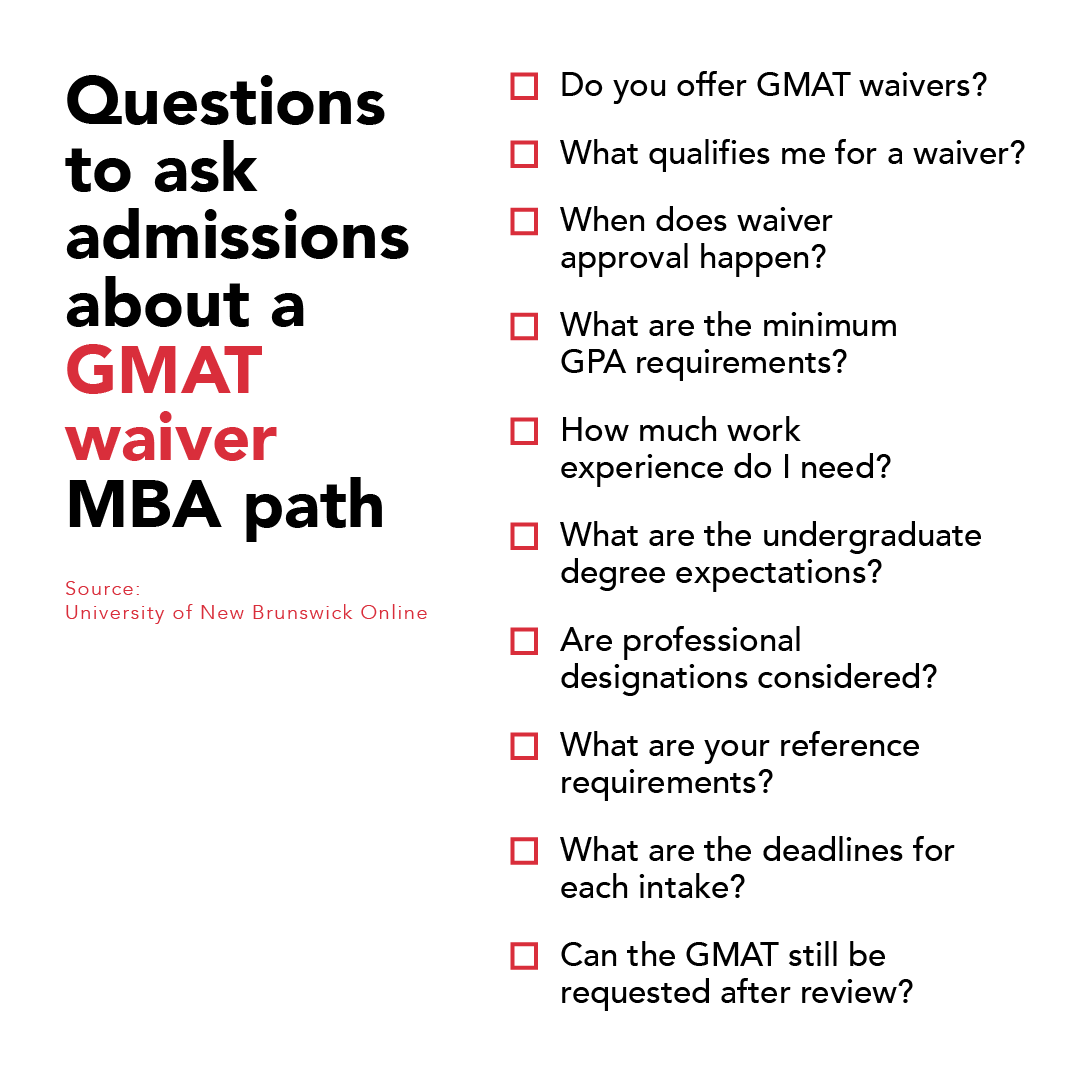
Once you’ve found a few programs that may fit, confirm the waiver process wth admissions as early as possible.
This includes asking about whether waiver approval happens before you apply or during the admissions review.
This step can save you time. It can also help you avoid submitting an incomplete application or misunderstanding a school’s policy.
Build a stronger profile
Start with your resume. Focus on outcomes, not just responsibilities, and include measurable achievements wherever possible.
Then think carefully about your references. Choose people who can speak to your judgment, communication skills, leadership potential and ability to handle complex work.
Next, your statement of intent should explain why you want an MBA, why now and why that specific program.
Avoid vague statements like “I want to become a better leader.” Instead, connect your goals to your experience and the program’s strengths.
For example, you might explain that you’re moving from technical execution into leading larger teams in operations, finance, analytics, entrepreneurship or general management.
Submit a polished application
Before you submit, review every requirement carefully. Missing transcripts, vague references or rushed essays can weaken an otherwise strong application.
Make sure your application includes:
- Complete transcripts
- Updated resume
- Strong references
- Clear statement of intent
- Waiver request, if required
- Proof of English language proficiency, if applicable
- Any supplemental documents requested by the school
If the school requests clarification, an interview or additional documentation, treat that as part of the evaluation process. Respond quickly and thoughtfully to admissions follow-up.
Example of a Canadian option with flexible access
UNB’s Online MBA is AACSB-accredited, can be completed in 8 terms (approximately 2.67 years) and offers a GMAT waiver for qualified applicants.
This kind of option may appeal to professionals who want a high-quality Canadian business education without relocating or stepping away from their jobs.
It also reflects the broader purpose of GMAT waiver pathways: helping qualified applicants access graduate business education through a process that recognizes both academic ability and professional experience.
Ready to move forward without the GMAT?
If you’re exploring a flexible Canadian MBA program, the University of New Brunswick offers an Online MBA designed for working professionals seeking career growth without putting life on hold.
Request program details or apply today to take the next step toward an AACSB-accredited MBA from Canada’s oldest English-language university business school.