

Changing careers is rarely about starting over.
More often, it’s about reaching a point where your experience has outgrown your role or your long-term goals require stronger credentials.
For career transitioners navigating shifting priorities such as income stability, family commitments and long-term planning, a business bachelor’s degree can offer a practical way forward.
It provides a broad, adaptable foundation that allows you to reposition yourself without leaving the workforce or starting at the entry level.
Why a business degree creates flexible career paths for career changers
One of the biggest advantages of a university business degree is its versatility.
Unlike highly specialized credentials that tie you to a single profession, university business degrees apply across industries and functions.
Business graduates work in finance, operations, marketing, human resources, project management, consulting and technology-enabled roles. These functions exist in nearly every sector, from healthcare and construction to non-profits and tech startups.
At the core of a business degree are competencies that transfer well between roles, including:
- Management and leadership fundamentals
- Strategic thinking and decision-making
- Financial and operational analysis
- Communication and stakeholder management
As these skills aren't industry-specific, they enable graduates to pivot as industries evolve.
This flexibility is especially valuable for those who may already have deep domain experience in one sector but want to apply it in a new context.
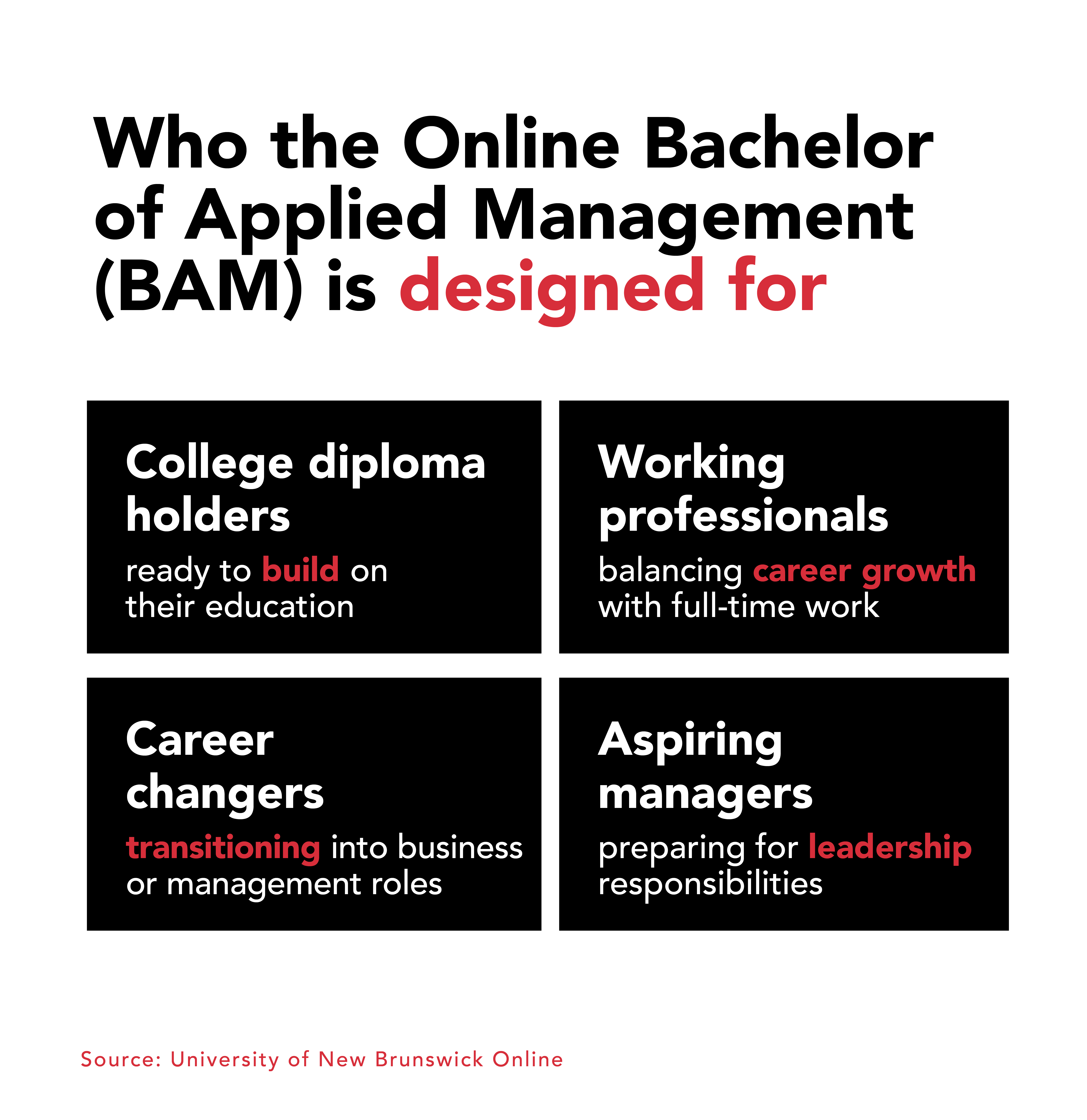
Aligning your experience with a new career path
A university business degree helps you reframe your past experience into future-facing roles.
For example:
- Someone coming from operations may transition into project management
- A frontline employee may move toward people leadership
- An administrative role can become a pathway into business analysis or management coordination
Transferable skills from professional experience, such as communication, problem-solving, collaboration and informal leadership, can also help reduce entry barriers.
In this way, the business degree acts as a bridge between where you have been and where you want to go.
Balancing a full-time job while preparing for a career change
Financial stability is often non-negotiable for adults considering a career change. Many learners pursue degrees while maintaining their day jobs, especially in their 30s and beyond.
This is consistent with Labour Force Survey data, which shows that over 40% of university students aged 30 and older are employed full-time while studying.
Online and flexible programs are designed with this reality in mind. They allow you to study alongside professional responsibilities rather than stepping away from the workforce entirely.
This model reduces financial risk while still enabling forward momentum and work-life balance.
Structured pacing is another advantage. Instead of the intensity of a short-term bootcamp or the rigidity of a traditional full-time student schedule, many programs allow consistent progress over time.
This reduces burnout and makes education more sustainable over the long term.
Why the Bachelor of Applied Management (BAM) works for career changers
The Bachelor of Applied Management (BAM) program at the University of New Brunswick is designed to build on existing college diploma education rather than treating learners as beginners.
This approach matters.
A transfer-focused structure reframes past education and experience as assets, not sunk costs, and supports transitions into management without forcing learners back into entry-level positions.
Applied coursework also reinforces existing skills instead of replacing them. This can be particularly helpful for countering imposter syndrome, which many career changers experience when returning to school later in life.
Another often-overlooked benefit is cohort composition, as the BAM program attracts working professionals across a range of ages and industries.
Learning alongside peers at similar life stages who are also moving toward a career shift can foster a more supportive academic environment.
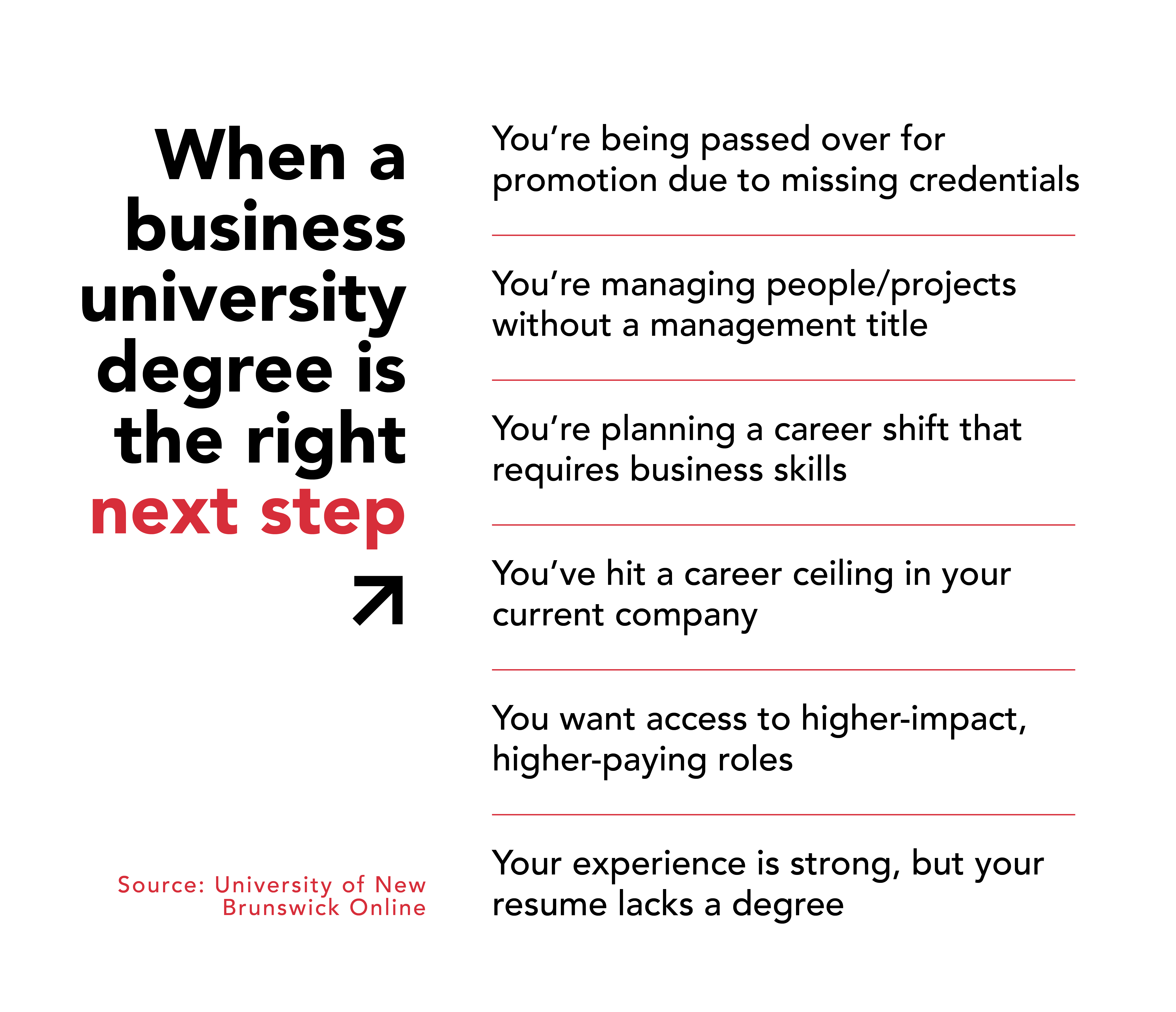
Staying or leaving your current company after you change careers
A common misconception is that a career change always requires changing employers.
In reality, internal advancement often becomes more accessible once you hold a recognized business degree.
Employers frequently reward upskilling with expanded responsibilities, promotions or lateral moves into strategic roles. A university degree can formalize your readiness for these opportunities and make it easier to initiate internal conversations.
For others looking to change careers, external opportunities may increase significantly once formal qualifications are added to their profiles.
This is supported by Lightcast data showing that approximately 40.7% of all Canadian job postings require a bachelor’s degree or higher.
Having the credential gives you options. Whether you stay or leave to pursue your chosen career becomes a strategic choice rather than a forced decision.
Full-time versus part-time study for career changers
The right study format depends on your life stage and risk tolerance.
Full-time study may accelerate transitions for those who can temporarily pause employment or reduce working hours. This approach often appeals to younger career changers or those with financial flexibility.
Part-time study, on the other hand, supports professionals balancing work, family and education. It allows steady progress without sacrificing income or personal stability.
Flexible delivery models matter here.
Business and management programs that allow learners to adjust their pace over time acknowledge that life changes and that work transitions shouldn't derail long-term goals.
Mapping next steps after earning a business degree
Effective career changers align academic outcomes with specific target roles early on.
This might mean strategically taking courses and electives, focusing on applied projects in relevant industries or building a professional network during the program.
Research from Universities Canada shows that adult learners in applied and professionally aligned programs report 88% confidence in their job readiness compared to those in purely theoretical pathways.
This can look like stepping into a new management position, moving into a more strategic function or expanding scope within an existing role.
The long-term value lies in positioning yourself for leadership-focused opportunities that evolve with your life experience.
Is a business university degree worth it for career changers?
From a return-on-investment perspective, bachelor’s degrees consistently outperform high school diplomas, college diplomas, certificates and associate degrees over the long term.
In fact, Statistics Canada reports that individuals with a bachelor’s degree earn, on average, 24% more over their lifetime than those with college credentials alone.
It's also important to note that a management-focused education can also improve job security across economic cycles.
According to Indeed Canada, roles that combine domain knowledge with management skills consistently rank among the most stable mid-career opportunities.
This is largely because business skills are highly transferable across industries, supporting opportunities over time and across diverse sectors.
Take the next steps with UNB’s Online Bachelor of Applied Management
For professionals with a college diploma seeking to achieve their personal and professional goals without starting over, UNB’s 100% Online Bachelor of Applied Management is designed with flexibility in mind.
This program supports learners working full-time and builds on prior education rather than duplicating it.
If you're exploring how to transition into management or expand your career options, you can learn more by requesting information or starting an application.