

Across Canada, select higher education facilities have developed structured post-diploma pathways that recognize previous college-level learning. This allows college diploma credits from accredited institutions to be applied to a four-year bachelor's university degree program.
Transferring college credits can significantly shorten the time it takes to earn a degree, making it an attractive option if you want to advance your education and professional opportunities.
Understanding how this process works helps you to make an informed decision about your next academic step.
What does transfer credit mean when moving from a college diploma program to a degree program?
Transfer credit refers to the recognition of previously completed post-secondary coursework toward the requirements of a new academic program.
In the Canadian post-secondary system, this typically means that courses completed during a college diploma may count toward a university degree.
When a university awards transfer credit, it acknowledges that certain learning outcomes from your diploma program align with degree-level expectations.
This alignment allows you to bypass introductory courses and focus on more advanced material.
The result is a shorter, more efficient path to a university degree that respects the time and effort you have already invested in your education.
Why are transfer opportunities important for diploma program graduates in Canada?
Transfer opportunities matter because they directly address some of the most common barriers you may face when considering further education.
It allows you to:
Save time
Returning to school for another four years may feel unrealistic, especially if you are already working or supporting a family.
When you receive credit for prior learning, it can reduce your learning time by one or more years, depending on the pathway structure and the number of credits awarded.
Lessen costs
According to Statistics Canada, the average undergraduate tuition for business, management and public administration programs in Canada is just over $8,298 per year.
Reducing the number of required semesters can translate into significant savings, both in tuition and related expenses like textbooks, transportation and lost income.
Reduce repetition
College diploma graduates often worry that university programs will force them to repeat material they already know.
Strong pathways for diploma transfer students are designed to build on applied, career-focused learning rather than replace it. This allows you to deepen your knowledge while continuing to develop practical skills.
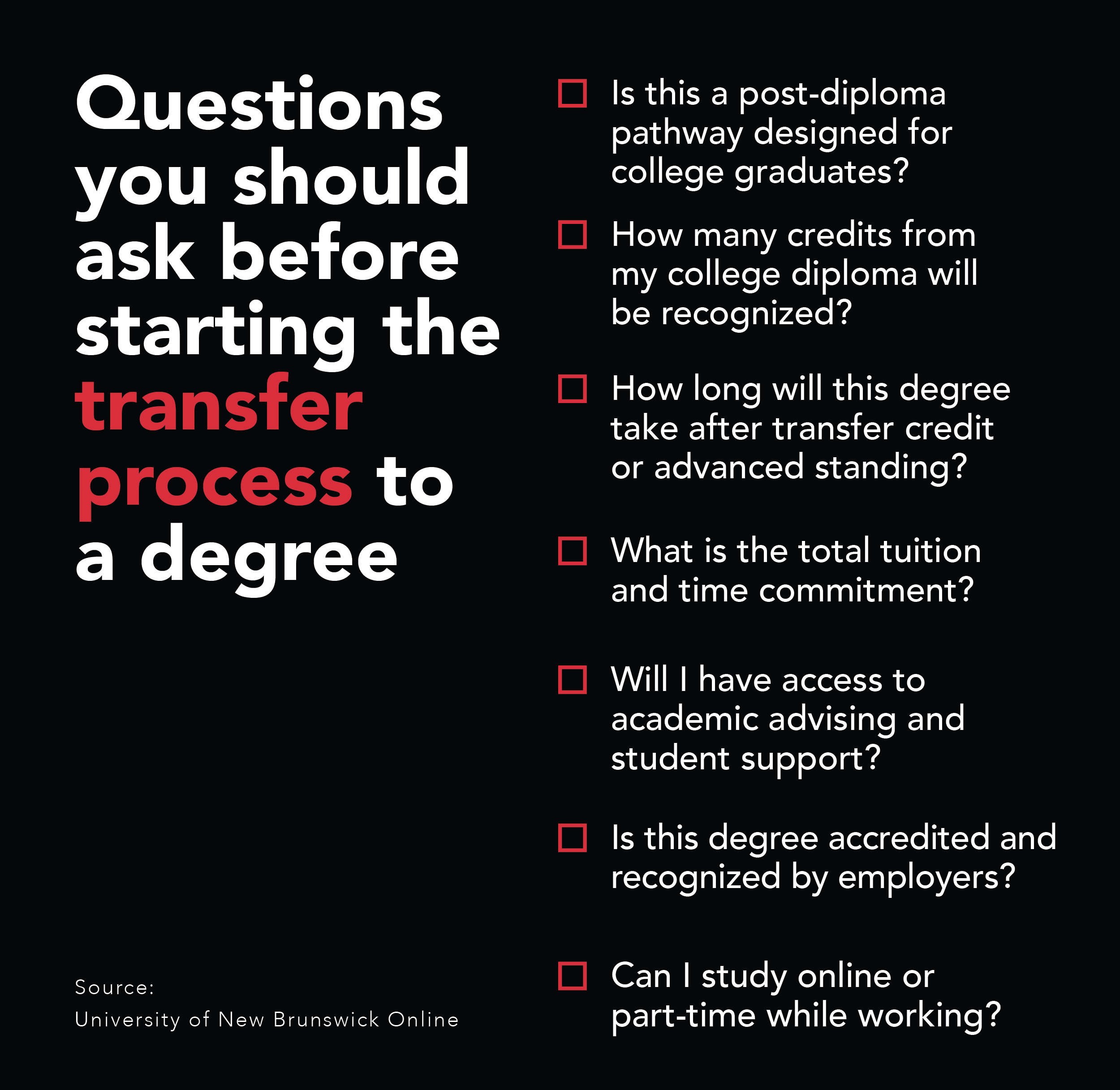
How does the transfer process work for a Canadian degree?
Post-secondary institutions maintain authority over determining when and what type of transfer they award. However, the transfer process at Canadian universities follows a fairly consistent structure.
You must first apply to the institution to which you wish to transfer and arrange to have official transcripts sent directly from your former institution(s). It is your responsibility to provide documentation from all prior postsecondary institutions for transfer credit evaluation.
Once your application is received, the university conducts a transfer credit assessment based on your transcripts. This involves comparing your completed coursework against the learning outcomes of courses within the degree program.
The goal is to determine where equivalencies exist and how much credit can be applied.
This assessment may be completed course by course or through a block credit model, depending on the program design. You'll receive transfer credit only if you are admitted to the institution and a related program.
The evaluation process can take 4 to 12 weeks after all documents are submitted, so it is advisable to apply early.
What transfer information do universities review during the transfer process?
Universities rely on several key pieces of information when reviewing transfer credit applications.
Official transcripts from a recognized college diploma program are essential. These confirm that your credentials were completed and provide the academic context needed for assessment.
In some cases, universities may request detailed course descriptions or syllabi, particularly if your diploma program is less familiar or if course titles do not clearly indicate content. Students are advised to provide detailed course outlines to facilitate the evaluation of transfer credits.
Institutional recognition also matters. Public colleges and well-established private institutions are more likely to be recognized for transfer credit. Accreditation and provincial oversight play a role in this determination.
Finally, relevance is important. Coursework that aligns closely with degree requirements is more likely to be approved than highly specialized or unrelated courses.
What program requirements should you expect?
Many post-diploma management degree programs share at least some standard entry requirements.
You will typically need a completed college diploma from a recognized institution. High school completion alone is not sufficient.
Minimum academic standing requirements also apply, often based on your cumulative grade point average. This is conveyed through your post-secondary transcripts. You generally need a passing grade (e.g., 70% or 'B') in your previous college diploma program courses to transfer credits.
For some universities, a language proficiency test or skills assessment (for subjects like math and English) may also be required as part of the transfer process. This is most common if your prior education was completed in a language other than English or outside Canada.
For credits earned outside North America, a credential evaluation may be required from agencies such as World Education Services (WES) or ICAS.
How can a post-diploma degree reduce duplication of learning?
Students who transfer at the postsecondary level typically present studies from varied learning experiences.
Traditional transfer credit often operates on a course-by-course basis. Each course you completed is matched individually against degree requirements, and may take the form of:
- Block credits. Instead of evaluating individual courses, the receiving institution recognizes the diploma as a cohesive body of learning and awards a fixed number of credits upfront.
- Advanced standing. With advanced standing, you enter the degree program beyond the first year and begin upper-level coursework immediately. This approach acknowledges that your college diploma has already covered foundational material.
- Unassigned transfer credits. Unassigned transfer credit represents situations when credit is granted at a year, subject level or to a particular thematic area but is not assigned to a specific course.
- Prior Learning Assessment Recognition (PLAR). PLAR credit refers to the recognition of learning outside of formal educational institutions that may be equivalent to postsecondary-level studies.
Compared with starting a new degree in year one, these models offer a more direct pathway that values your prior education.
What should you look for when comparing transfer opportunities across universities?
Transparency should be high on your list. Universities that provide detailed explanations of how transfer credit works, what credentials are accepted and how much credit is typically awarded make it easier to plan your next steps.
Published transfer information and access to advising support are also important. Speaking with an advisor who understands post-diploma pathways can save time and reduce uncertainty.
Flexibility also matters, especially if you are working. Online or hybrid delivery, part-time options and predictable course scheduling can make the difference between finishing your degree and putting it off indefinitely.
Lastly, accreditation and recognition should not be overlooked.
Programs offered through accredited faculties are often viewed more favourably by employers and graduate schools, and this distinction can matter long after graduation.
How does the Bachelor of Applied Management fit into transfer pathways in Canada?
Unlike traditional Bachelor of Commerce or Bachelor of Business Administration programs, UNB’s Bachelor of Applied Management is designed specifically for college diploma graduates.
The curriculum assumes prior exposure to business fundamentals from a previous institution and focuses on developing leadership, strategy and decision-making skills.
Our program recognizes prior college-level learning through block credit, allowing students to complete their degree in fewer courses than a standard four-year program.
The management-focused curriculum also aligns closely with real-world roles across industries, from operations and human resources to project management and business development.
Lastly, it is also offered entirely online, supporting learners across Canada who may not live near a campus or who need flexibility to balance work and study.
How can a Bachelor of Applied Management degree help you reach your long-term career goals?
According to data from Universities Canada, there has been a 115% increase in management and professional roles that list a bachelor’s degree as a minimum requirement.
In fact, an analysis of job postings by the Burning Glass Institute shows that roughly 75% of roles requiring business or management skills specify a bachelor’s degree or higher.
UNB’s Bachelor of Applied Management prepares you for leadership and management responsibilities by building on your existing knowledge while expanding your strategic perspective.
You gain tools to analyze complex problems, lead teams, manage change and contribute at a higher level within your organization.
In addition, our Bachelor of Applied Management creates pathways to further education. Graduates may pursue graduate-level business programs, including an MBA, using their applied management degree as a foundation.
Move forward with UNB's Bachelor of Applied Management
Take the next step toward your degree with UNB's Bachelor of Applied Management.
Our fully online program is designed for college diploma graduates seeking a faster, more focused path to a bachelor’s degree.
Learn how receiving transfer credit can shorten your path to graduation, explore program details or apply today to build on your college diploma.