

Key takeaways
- An MBA is generally the better fit if you want to apply analytics to leadership, strategy, management or cross-functional decision-making.
- A Master of Management Analytics is generally the better fit if you want deeper technical training for analytics, data science or modelling roles.
- Business analytics is now relevant across finance, marketing, HR, operations and supply chain, not only technical data teams.
- Your best ROI comes from choosing the degree that matches your future role, not simply the one that sounds more specialized.
Both an MBA and a Master of Management Analytics can open doors to rewarding, data-driven careers.
While both programs develop analytical thinking and decision-making skills, they are designed for different career trajectories.
Understanding how each program aligns with your professional goals, interests and preferred work style can help you choose the path that delivers the greatest long-term value and return on your educational investment.
What is the core difference between an MBA and a Master of Management Analytics?
An MBA is a broad business leadership degree, while a Master of Management Analytics is a specialized technical analytics degree.
An MBA program typically combines leadership, financial management, strategy, operations, people management, marketing, governance and analytics. It’s designed to help you understand how organizations work, how decisions are made and how teams move from insight to action.
A Master of Management Analytics focuses more deeply on data analytics, modelling, data tools, coding, machine learning, statistics and technical problem-solving. It’s designed for people who want analytics to be the centre of their work.
Both pathways can support data-driven careers. The difference is influence and focus.
While both programs help you develop analytical thinking, they prepare you for different types of responsibilities within an organization.
When does an MBA make the most sense?
An MBA makes the most sense when you already have work experience and want to move into leadership, management or strategy.
It can be especially valuable if you want to understand analytics without becoming a full-time data scientist. You may want to ask better questions, translate complex data for decision-makers or lead teams that rely on business intelligence.
An MBA can support roles such as:
- Analytics manager
- Average salary in Canada: $102,00
- Business intelligence leader
- Average salary in Canada: $103,000
- Data product manager
- Average salary in Canada: $92,000
- Operations manager
- Average salary in Canada: $75,000
- Marketing analytics manager
- Average salary in Canada: $105,000
- Finance transformation manager
- Average salary in Canada: $85,000
Source: Glassdoor, 2026
Your ROI typically comes from developing a broader skill set that's valuable across industries and the job market.
You’re building a foundation across finance, business administration, operations, HR, strategy, marketing and governance, while adding analytics fluency to your leadership toolkit.
When does a Master of Management Analytics make the most sense?
A Master of Management Analytics makes the most sense when you want a more technical, analytics-centred career path.
Bridging the gap between technical data and executive strategy is a key focus of this program, preparing graduates for specialized consulting and technical strategy roles.
This path is often a strong fit for people with quantitative, STEM, business, economics or technical backgrounds who want to build stronger credentials for analytics-specific careers.
Graduates of Master's in Management Analytics programs can pursue various roles such as:
- Data analytics specialist
- Average salary in Canada: $77,000
- Data scientist
- Average salary in Canada: $92,000
- Business analytics consultant
- Average salary in Canada: $93,000
- Machine learning analyst
- Average salary in Canada: $99,000
- Technical analytics specialist
- Average salary in Canada: $88,000
- Predictive analytics specialist
- Average salary in Canada: $79,000
Source: Glassdoor, 2026
This route may offer strong early-career ROI if your goal is to enter analytics quickly or compete for positions where technical tools, statistical modelling and coding are central.
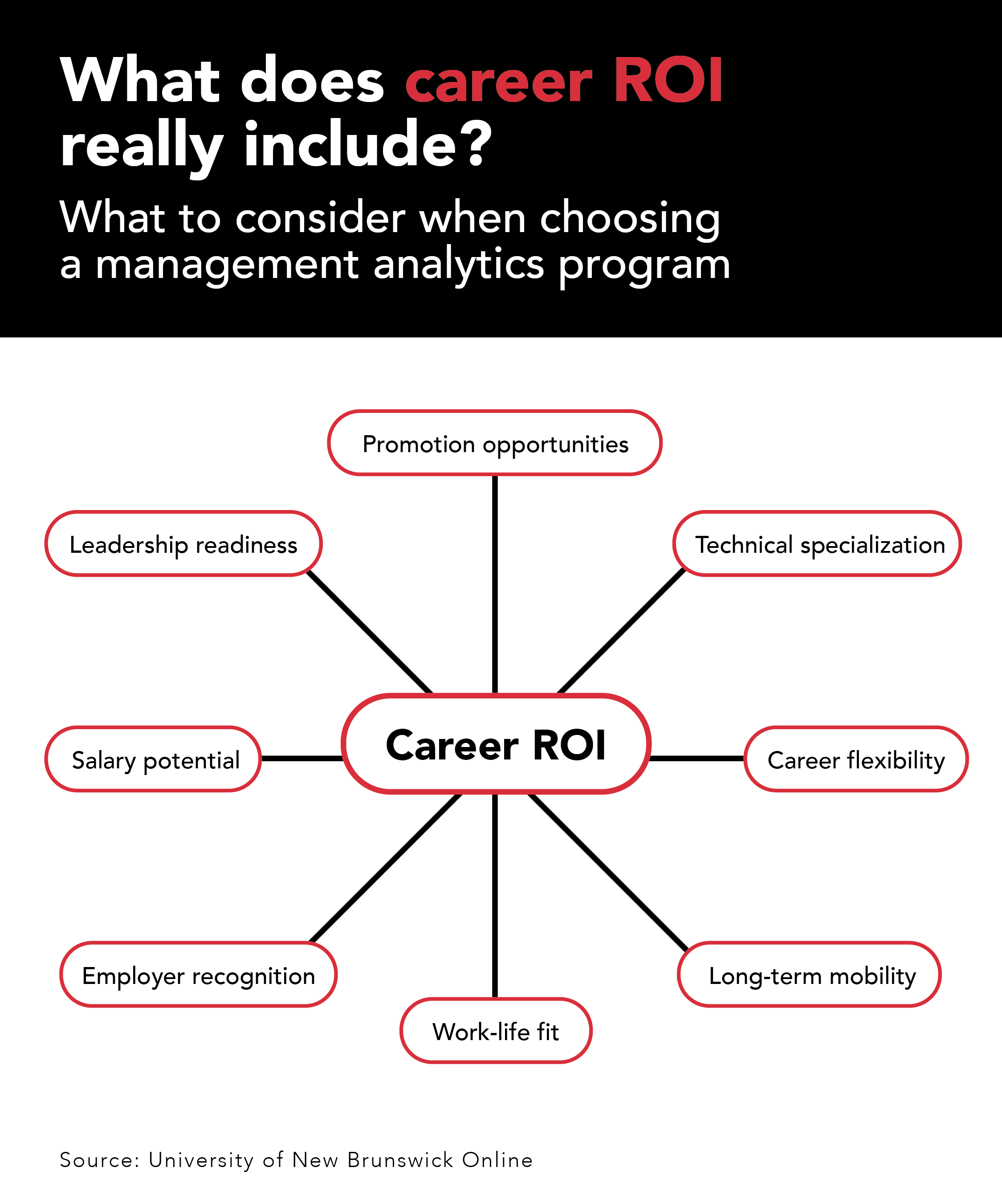
How does business analytics shape the ROI of each path?
The World Economic Forum’s Future of Jobs Report 2025 identifies analytical thinking as the top core skill for employers, with seven in 10 companies considering it essential. It also identifies AI and big data as the fastest-growing skills.
In this context, business analytics shapes ROI by determining how well your degree helps you use data in the work you actually want to do.
For MBA students, the value is often in applying analytics to business decisions.
For Master of Management Analytics students, the value is often in building the analysis itself.
That means the key question regarding ROI isn’t “Which degree is better?” It’s “Which degree better supports the work I want to do next?”
How much data science depth do you need?
You need deeper data science training if your goal is to build models, code solutions or work directly in machine learning, AI or advanced analytics.
Data science roles often require programming, data management, statistical modelling, data engineering concepts, machine learning and strong technical problem-solving.
This is more aligned with a Master of Management Analytics.
However, many organizations also need leaders who have a deeper understanding of data outputs, ask better questions and turn analysis into decisions.
That’s where an MBA, especially one with a concentration in management analytics, can make sense. You don’t need to be the person building the model to be the person leading the strategy it informs.
To summarize, if you want to become a technical analytics specialist, a Master of Management Analytics may be the most logical choice. If you want to become a business leader who works confidently with analytics teams, an MBA may be the stronger fit.
How should career goals shape your master’s pathway?
Your career goals should shape your degree pathway by clarifying whether you want technical specialization, business leadership or a blend of both.
MBA
An MBA may appeal to you if you’re seeking dual fluency in analytics and business leadership.
It's a strong fit if you don’t want to become a pure technical specialist but still want to use data at a high level.
It also supports goals such as moving into management, leading analytics-informed teams, becoming a business intelligence or analytics manager, moving into strategic consulting or leading digital transformation.
It can also be relevant if you want to use data to guide marketing, finance, HR or operations strategy.
Master of Management Analytics
A Master of Management Analytics may appeal to you if you enjoy technical problem-solving more than people leadership or business strategy.
This pathway can also be useful if you already have business experience but need stronger technical analytics credentials. It’s often preferred when you want to compete for roles where coding, modelling and technical analytics are central.
It also supports career goals such as becoming a data scientist or machine learning analyst, moving into predictive modelling, building dashboards and models or working in a data science, analytics or AI function.
How can supply chain, finance, marketing and operations professionals apply each pathway?
The World Economic Forum expects 39% of workers’ core skills to change by 2030, which reinforces the value of adaptability across industries.
That's why it's important to note that professionals outside traditional tech roles can still benefit from analytics-focused graduate education.
Supply chain management
MBA: Aligned with supply chain leadership, procurement strategy, operations improvement and cross-functional decision-making.
Master of Management Analytics: Stronger for demand forecasting, inventory analytics, modelling and optimization-heavy roles.
Finance
MBA: Better for financial strategy, corporate finance leadership, analytics-informed decision-making and management.
Master of Management Analytics: Stronger for risk modelling, advanced reporting, forecasting and technical analytics.
Marketing
MBA: More focus on marketing strategy, customer insight, brand performance and executive communication.
Master of Management Analytics: Better for marketing analytics, attribution modelling, segmentation and experimentation.
Operations management
MBA: Stronger program for developing operational leadership skills, performance improvement, change management and strategy execution.
Master of Management Analytics: Better for process analytics, data modelling and operational forecasting.
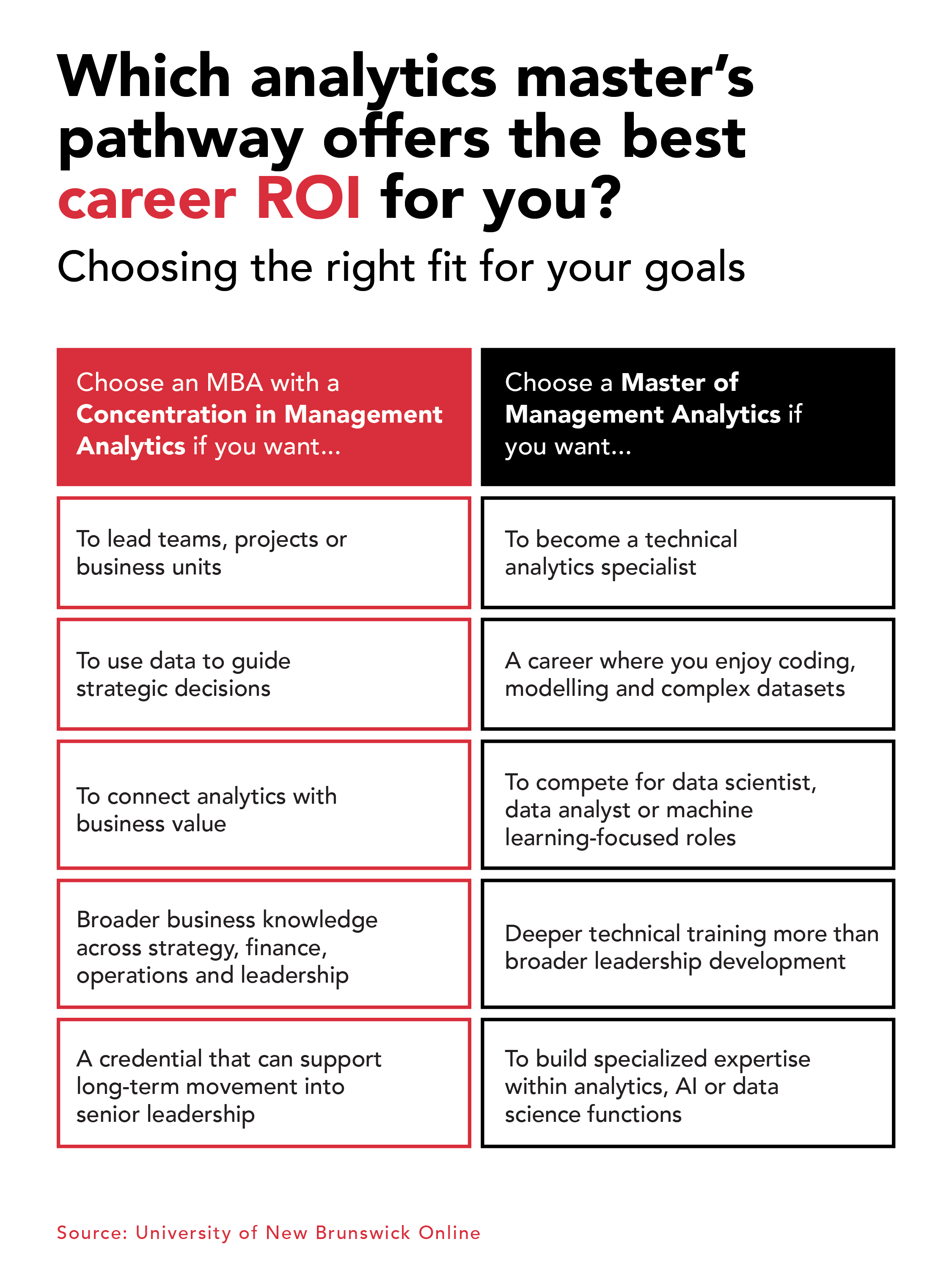
Choosing the right fit for your goals
How can you compare long-term mobility across both pathways?
Neither path is inherently more valuable for every student.
The demand for professionals with analytical skills is increasing, with companies struggling to fill roles that require data skills, highlighting the importance of both MBA and Master's in Management Analytics graduates in the job market.
An MBA with a Concentration in Management Analytics supports mobility across management, strategy, consulting, operations, marketing, finance and leadership.
Its business breadth can help you move across functions or into roles where you need to lead teams, budgets and strategy.
On the other hand, a Master of Management Analytics supports strong mobility within analytics, data science, AI, business intelligence and technical consulting.
Its technical depth can help you become more competitive for specialized analytics roles. Students in Management Analytics programs can also gain skills applicable to certifications such as the Certified Analytics Professional (CAP) and the Project Management Professional (PMP).
If you want to keep your options broad, the MBA may offer stronger cross-functional mobility. If you want to deepen your technical specialization, the MMA may offer a clearer analytics-focused pathway.
Take your next step with UNB’s Online MBA
UNB’s Online MBA is a flexible path for working professionals who want to strengthen leadership, business strategy and analytics skills without putting their careers on hold.
If you want to translate data into smarter business decisions, the MBA with a Concentration in Management Analytics can help you build the business and analytics fluency needed to lead with confidence.
Request more information to learn how UNB’s Online MBA aligns with your career goals, or apply today to get started.
Key terms
Business analytics: The use of data, statistical methods and business context to support stronger decisions.
Career ROI: The long-term value of an education pathway based on cost, time, salary potential, promotions, mobility and career fit.
Data science: A more technical field focused on extracting insights through programming, modelling, machine learning, statistics and data systems.
Machine learning: A branch of artificial intelligence that enables computer systems to identify patterns in data and improve predictions or decisions without being explicitly programmed for every task.
Management analytics: The application of analytics to leadership, operations, strategy, finance, marketing and other business functions.
Master’s degree: A graduate-level academic credential earned after completing an undergraduate degree.
Undergraduate degree: A post-secondary academic credential, such as a bachelor’s degree, typically completed before pursuing graduate-level education like an MBA or Master of Management Analytics.