

Choosing between a college diploma and a university bachelor’s degree is an important educational decision Canadians face, especially when career outcome, stability and salary are on the line.
You might be asking yourself practical questions like: "Will a university degree actually lead to higher pay?" or "Is a college diploma enough to get me to where I want to be professionally?"
To help you find these answers, let's look at the difference between a bachelor’s degree and a college diploma through the lens of earnings, advancement and career flexibility.
Understanding a bachelor’s degree and how degree programs work
A bachelor’s degree in Canada is an undergraduate university credential that typically requires three to four years of full-time study, which equates to about 40 courses.
Most bachelor’s degree programs share several core characteristics:
- A structured curriculum that builds from foundational knowledge into advanced concepts
- Emphasis on critical thinking, analysis and decision-making
- Exposure to theory alongside real-world applications
- Assessment through projects, case studies and exams
Unlike short-cycle credentials, bachelor’s degrees are designed to develop long-term practical skills and professional capability. Graduates are expected to evaluate problems, manage people and make informed decisions under uncertainty.
This structural depth is one reason why degrees are often required for leadership, analysis and management roles across industries.
Insights into college diplomas and short-cycle credentials
College diplomas are a cornerstone of Canada’s postsecondary system and play an important role in workforce development.
Most college diplomas are two to three years in length, between 20 and 30 courses and focus on practical, job-ready skills.
These programs are especially effective for learners who want to enter the workforce quickly or build a technical foundation in a specific area.
This is not to be confused with an associate degree program, a two-year, 20-course undergraduate program that provides a foundation in the arts or sciences.
It's also worth mentioning that certificate programs, which are even shorter, typically fit into targeted upskilling or reskilling. They're valuable for acquiring specific competencies but generally don't replace the broader credential value of a college diploma or university degree.
How university and college credentials shape earning potential
In the Canadian labour market, educational credentials act as signals. They help employers assess what you know and how far you may be able to grow within an organization.
At a high level, college diplomas and university degrees serve different purposes:
- College diplomas are typically designed to prepare graduates for entry-level or technical roles. They typically emphasize applied technical skills, job readiness and faster entry into the workforce.
- University bachelor’s degrees tend to focus on broader analytical skills, financial reporting, critical thinking, leadership development and long-term professional growth.
Employers often interpret these credentials differently when making hiring and promotion decisions.
A college diploma may be sufficient for operational roles, but a bachelor’s degree is frequently viewed as a prerequisite for management-track positions.
What is the average salary for college diploma and bachelor's degree holders in Canada?
According to Glassdoor, those with a bachelor’s degree earned more on average than those with a college diploma.
In 2026, the median income for individuals with a bachelor’s degree was approximately $55,000, compared to about $35,000 for those with a college diploma.
Over time, this gap may widen as degree holders gain access to higher-responsibility roles that come with increased compensation.
Business administration and business management as career foundations
Business administration and business management degrees are among the most versatile credentials in the Canadian labour market.
Rather than training graduates for a single job, they build transferable skills that apply across sectors.
Business administration programs focus on how organizations operate, including corporate finance, marketing, human resource management and operations.
Business management programs build on this foundation, emphasizing leadership, strategy, business ethics and decision-making.
Graduates develop skills that are valued in almost every industry, such as:
- Business analysis and problem-solving
- Team leadership and communication
- Strategic planning and execution
- Financial management and operational oversight
This transferability is a key reason business degrees often lead to stronger long-term earning potential.
Business degree salary trends and career outcomes in Canada
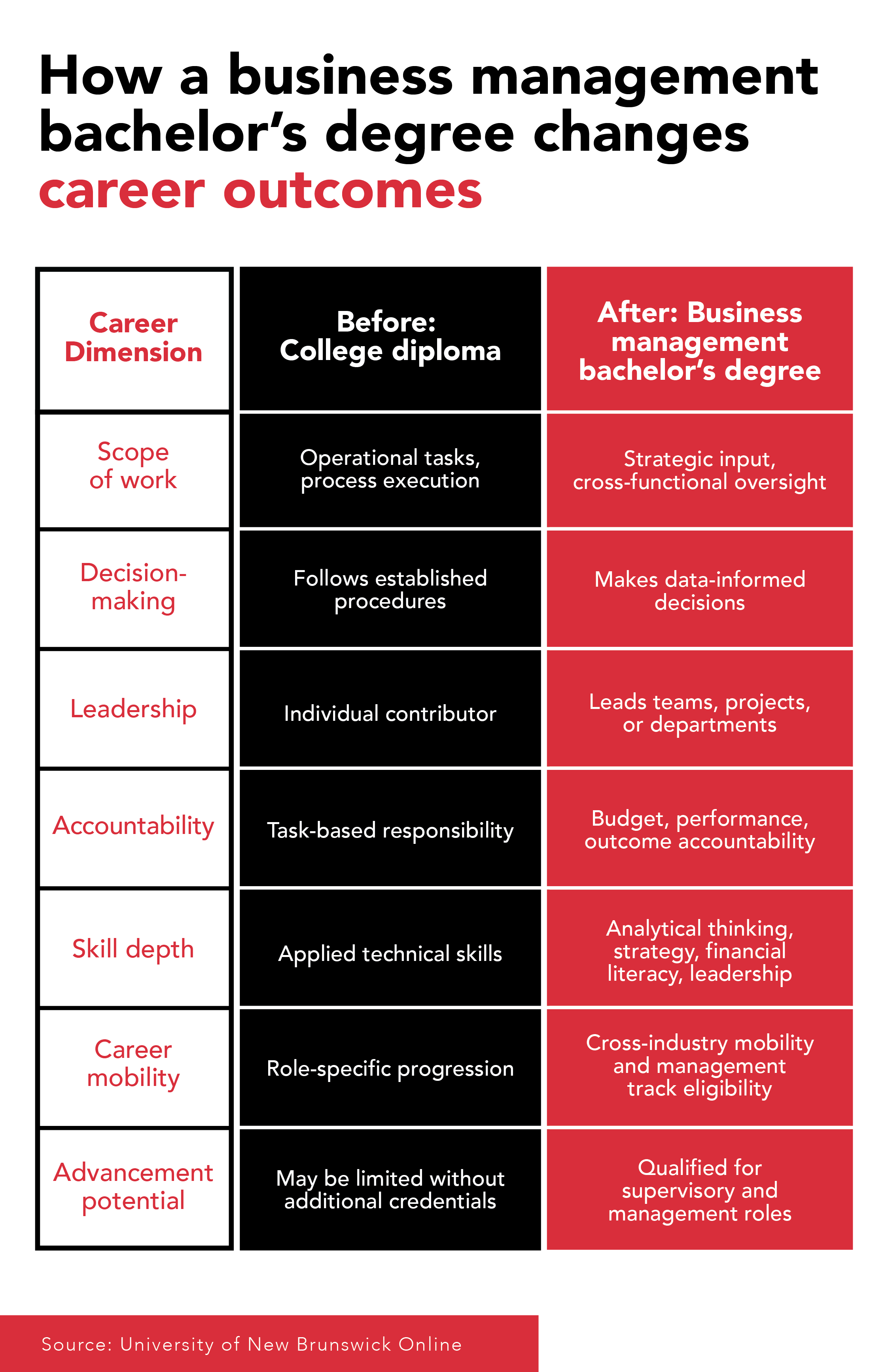
Salary outcomes for business graduates vary by role, industry and region, but national data shows consistent patterns.
According to 2026 labour statistics from Glassdoor:
- Entry-level undergraduate business degree graduates often earn between $50,000 and $60,000 annually
- Mid-to-late career professionals with management responsibilities frequently earn $75,000 to $90,000 or more, with senior roles potentially earning more.
In contrast, business diploma holders may experience slower salary growth once they reach the ceiling of operational roles.
While experience matters, many organizations require a bachelor’s degree for advancement into management.
Aligning your education choice with career goals and long-term mobility
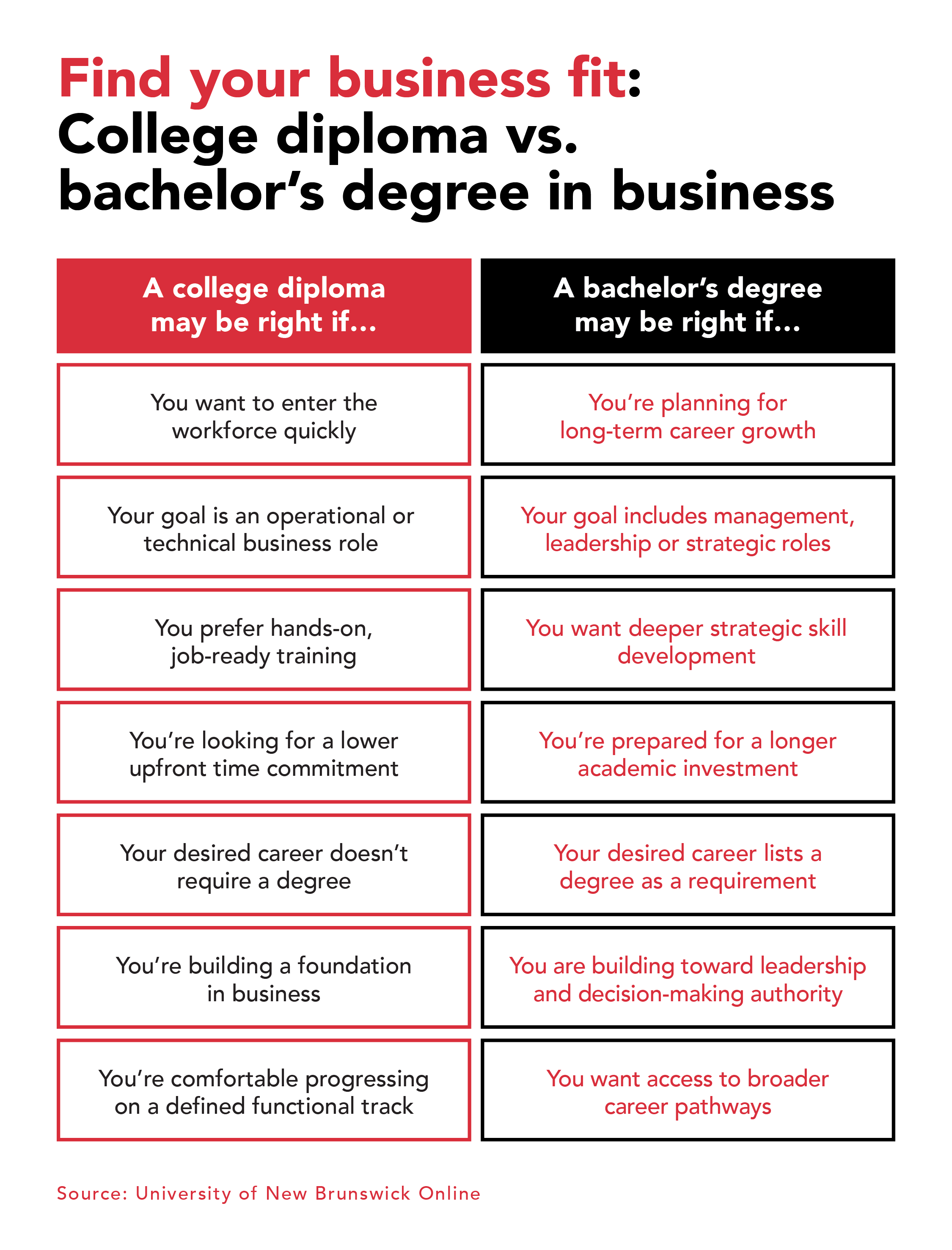
If your long-term goals include managing people, leading projects or influencing business strategy, a bachelor’s degree in management is often a requirement.
In fact, many leadership pathways explicitly list a degree as a minimum qualification.
However, there are scenarios where a college diploma program may be the right choice:
- You want to enter the workforce as quickly as possible
- Your career goals are directed to technical or operational roles
- You plan to return to school later once you gain experience
The key consideration is return on investment.
While a degree can require more time and financial commitment, it often pays off through higher lifetime earnings and broader career mobility. It can also support those looking to attain a master's degree in the future.
Find your business fit: College diploma vs. bachelor’s degree in business
Business degree pathways that build on a college education
There are Canadian universities that offer transfer pathways that allow graduates of a college diploma to earn a bachelor’s degree without starting over.
These programs recognize prior learning and focus on building advanced management and leadership skills.
Applied and management-focused degrees are especially valuable in this context.
Programs like UNB’s Online Bachelor of Applied Management are designed as second-entry degrees that build directly on college education rather than duplicating it.
This approach allows diploma graduates to accelerate time to degree completion, increase earning potential without stepping away from work and create long-term flexibility for graduate studies or leadership roles
Stacking credentials strategically can improve career resilience in a changing labour market.
Final considerations when choosing a college diploma or degree program
Start by thinking about where you want to be in five to ten years.
If you see yourself supervising teams, managing budgets or influencing strategy, a bachelor’s degree may position you more effectively for those responsibilities.
At the same time, a college diploma can be a strategic first step if your priority is entering the workforce quickly, gaining hands-on experience or minimizing upfront costs.
You should also consider:
- Time commitment. Are you prepared for a longer academic investment, or do you need a faster credential right now?
- Financial capacity. What are the tuition costs, potential lost income and long-term earning gains?
- Learning style. Do you prefer applied, job-ready training or deeper academic exploration and theory? You should also consider modality, such as in-person or online learning options.
- Industry expectations. Does your target career path require a degree for advancement?
Finally, think about flexibility. Education doesn't have to be linear.
Many Canadians stack credentials over time, using a college diploma as a foundation and a degree as a growth accelerator.
Build on a college diploma with UNB’s Online Bachelor of Applied Management
If you’re ready to turn your college diploma into a management-focused bachelor’s degree, UNB’s Online Bachelor of Applied Management offers a way to invest in your long-term career outcomes.
With flexible, fully online delivery, the program is built for working professionals across Canada who want to advance without putting their careers on hold.
Request more information about this college diploma-to-degree pathway, or begin your application today.