

Choosing an undergraduate business degree is an important decision, especially in a market where program formats, delivery models and credentials vary widely.
You want flexibility. You want a credential that is broadly recognized. And you want to be confident that the time and money you invest will support real career progression.
Below, we'll walk you through how undergraduate business degrees work in Canada, what makes a credential recognized, how online delivery has changed and how to think strategically about long-term outcomes.
Understanding recognized business administration credentials in Canada
In Canada, the term “recognized” has a very specific meaning in education. It's not about popularity or name recognition alone. It's about whether a credential meets established academic and institutional standards.
From an employer's perspective, this high-level recognition matters. According to Job Bank Canada, 65% of business management job postings require a bachelor’s degree or higher.
To clarify, a recognized business administration credential typically meets the following criteria:
- It's issued by a public university or an authorized degree-granting institution
- The program aligns with provincial quality assurance requirements
- The academic institution is accountable to a provincial ministry of education
- The credential is clearly identified as a bachelor’s degree (not a diploma or other non-degree credential)
Within universities, schools of business may also hold additional accreditation, such as with the Association to Advance Collegiate Schools of Business (AACSB).
While not required, accreditation signals that a business school has met global standards for curriculum, faculty quality, business acumen and learning outcomes.
Comparing undergraduate management degree options available online
Online delivery has expanded access to undergraduate business education across Canada.
Today, you can complete a full business management degree without relocating or leaving the workforce. However, there are a variety of options, and choosing the right fit for your goals is important.
Some programs emphasize theory and discipline-specific depth. Others prioritize applied learning and workplace relevance.
Understanding these differences helps you choose a program that aligns with your career goals rather than defaulting to the most familiar title.
Bachelor of Commerce vs. Bachelor of Business Administration
A Bachelor of Commerce (BCom) is often academically rigorous and discipline-focused.
These programs typically emphasize areas such as accounting, economics, financial planning, risk management and quantitative analysis. They're well-suited for students planning to pursue specialized roles or further academic study in business-related fields.
On the other hand, a Bachelor of Business Administration (BBA) typically provides broader exposure across management disciplines.
You'll usually see coursework in leadership, operations, marketing, human resources and strategy. The focus is often on preparing graduates for general management roles rather than technical specialization.
In practice, one degree is not inherently better than the other. The right choice depends on your background and where you want your career to go.
Bachelor of Applied Management
A Bachelor of Applied Management (BAM) is an undergraduate business degree that focuses on management practice, leadership and decision-making in real organizational settings.
You’re still developing the fundamentals, but the learning is typically framed around real workplace contexts and practical management challenges.
In many cases, it’s positioned as a generalist management degree, providing broad exposure to core business functions while keeping the emphasis on how management actually works day-to-day.
Applied management can differ from more traditional business degrees in a few ways:
- A management-first curriculum focused on people leadership, operations, strategy and execution
- More applied assessment through projects, scenarios and case-based decision-making
- Interdisciplinary course design that connects business concepts to real organizational environments
- Experiential learning opportunities that emphasize application over memorization
Transfer pathways are a separate, important consideration
It’s also important to separate the business degree itself from how you enter it.
Some programs, such as the Online BAM offered at UNB, are structured as transfer programs, meaning they are designed for learners who have completed a college diploma and want to apply prior post-secondary learning toward a bachelor’s degree.
In these cases, the transfer structure can reduce duplication and shorten the path to completion, depending on your academic background and the program’s policies.
Why experiential learning matters in a bachelor’s degree in management
Research from the Agilus Work Solutions shows that employers consistently rank problem-solving, communication and applied decision-making as top hiring priorities.
These skills are developed through experience, not lectures alone; therefore, a program's stance on providing hands-on experience must be considered.
In a business context, experiential learning means applying concepts rather than memorizing them. It bridges the gap between theory and practice, which is exactly what employers are looking for in new graduates.
It's also why experiential learning is one of the most important indicators of quality in an undergraduate management degree, especially in an online program.
Experiential learning formats in online programs
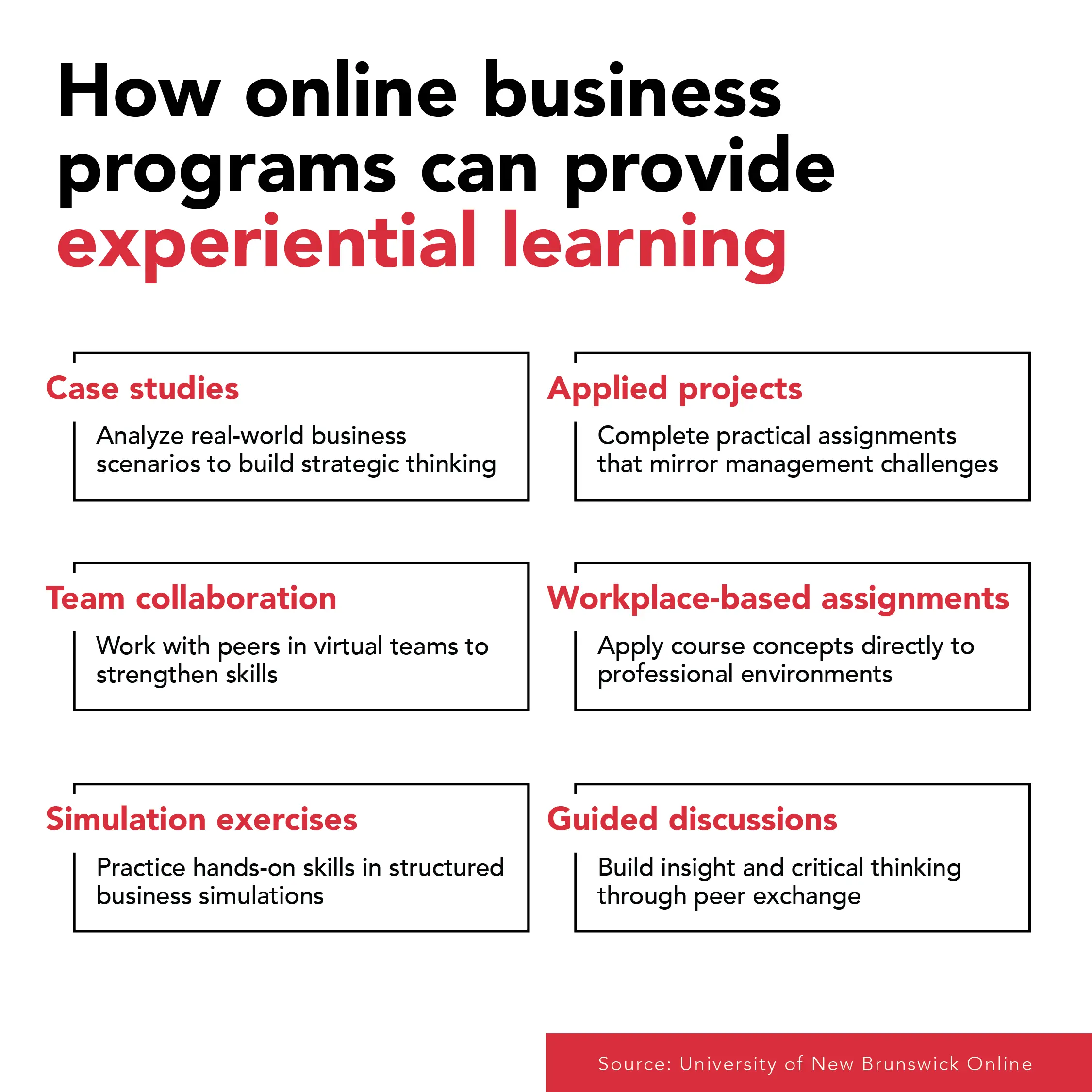
Online programs can deliver experiential learning effectively when designed well. You should expect learning activities that mirror workplace realities, with the most common formats including:
- Case studies based on real organizations and experienced leaders
- Applied projects tied to industry scenarios that drive critical thinking
- Group work that simulates team-based environments
- Assessments focused on analysis and recommendations
Rather than testing memorization, these assessments evaluate how you think, decide and communicate in practical, real-world scenarios.
Benefits of online programs for working professionals
In a recent report from the Canadian Digital Learning Research Association, 94% of learners agreed that online or hybrid programs helped them manage competing priorities, such as work, family, and hobbies.
This shows that, for many Canadians, online learning is about access and sustainability. Online delivery allows them to:
- Continue working while studying
- Avoid relocation or commuting costs
- Study from anywhere in Canada
Financially, online undergraduate programs in management can also reduce indirect costs such as transportation, housing and time away from work. That matters when you’re making a long-term return-on-investment decision.
That said, institutional reputation still matters. Employers care where a degree comes from, even if it is completed online.
Choosing a university with a strong academic track record helps ensure your credential is respected.
Where education fits into long-term management planning
Alternative education pathways, such as graduate certificates and short college diploma programs, play an important role in business careers. However, it serves a different purpose than a university degree.
These programs are typically ideal when you need to:
- Update very specific skills
- Respond to changes in your role
- Explore a new area before committing to a full degree
It's important to note that continuing education isn't a substitute for a bachelor’s degree when management roles require formal credentials.
In those cases, certificates are best viewed as complementary rather than comparable alternatives.
Online Bachelor of Applied Management as a pathway to an Online MBA
According to AACSB, enrolment growth has been strongest in business programs that demonstrate clear academic pathways and applied relevance.
This includes providing a track to graduate school, most notably an MBA, where an undergraduate degree is often required.
An Online Bachelor of Applied Management supports this executive development by reducing duplication between undergraduate and diploma coursework, making the path to future study more efficient.
If an MBA is part of your long-term plan, online or otherwise, it's worth asking how your undergraduate degree aligns with that goal from day one.
Accreditation and reputation when choosing a school of business in Canada
Accreditation provides an additional layer of quality assurance when it comes to university degrees.
AACSB accreditation, for example, is held by fewer than 6% of business schools worldwide. While not mandatory, an AACSB-accredited program signals a commitment to continuous improvement and global standards, both of which are professionally desirable.
However, it's also important to note that reputation extends beyond accreditation.
Longevity, alum networks and employer partnerships all shape how a degree is perceived in the market. That's why it's crucial to thoroughly consider both when looking for the right program pathway.
Choosing the right management degree for your career stage in Canada
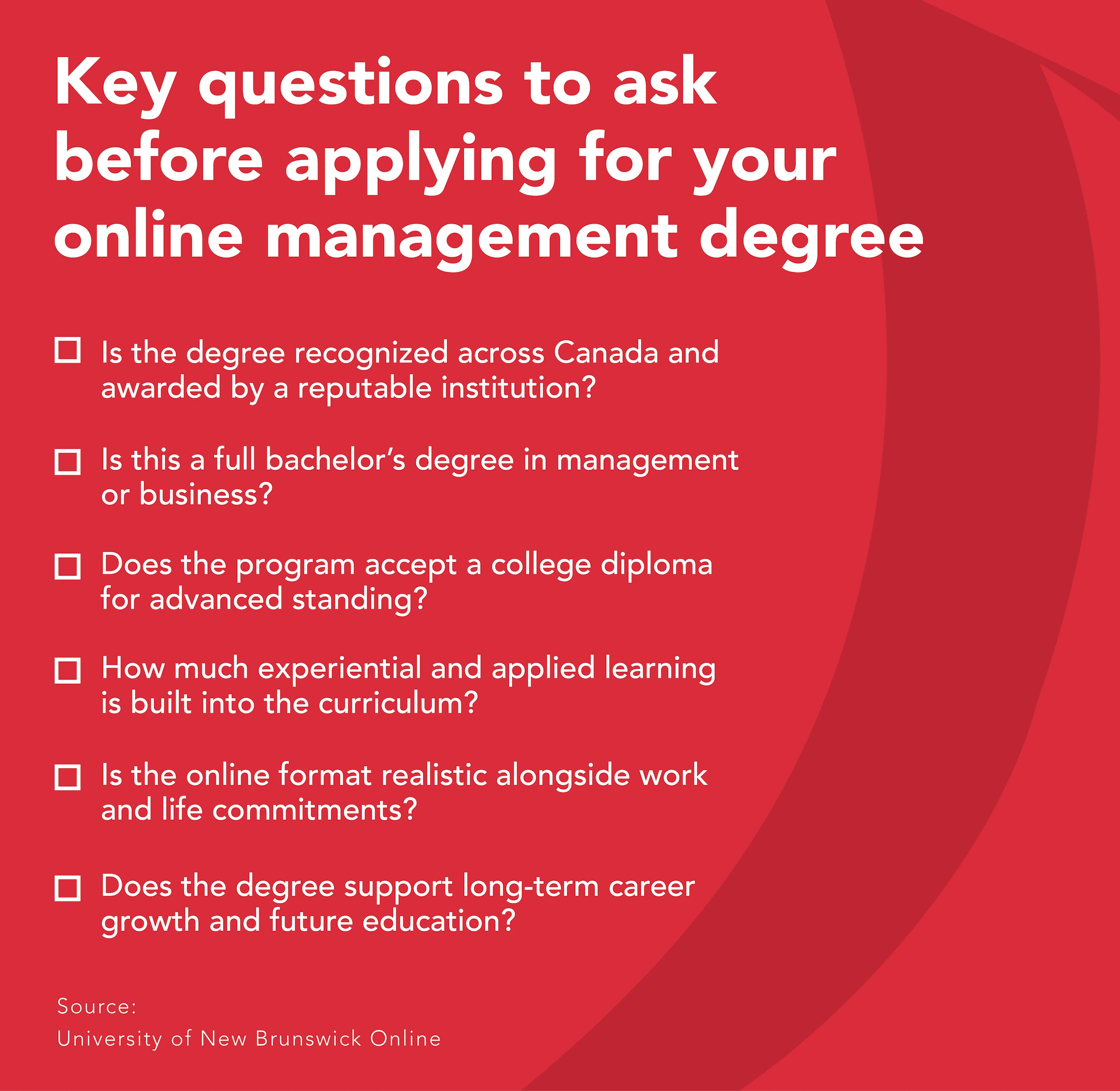
Your career stage should guide your decision as much as the degree title itself.
If you're early in your career, flexibility and foundational management skills matter most. If you're advancing or changing careers, applied learning and recognition of prior experience become exceedingly important.
For working professionals, the right program balances:
- Flexibility without sacrificing academic quality
- Practical outcomes without limiting future options
- Core and elective courses that don't duplicate prior learning
- Recognition across Canada
Keep in mind that there's no single “best degree”. There's only the degree that best fits where you are now and where you want to go next.
Explore a Bachelor of Applied Management at UNB Online
If you hold a college diploma and are ready to build on your education, UNB's 100% Online Bachelor of Applied Management offers a practical, accessible and recognized pathway forward.
Now is the time. Support your career growth and keep future academic opportunities open.
Get more information today or apply now to get started.