

Moving from a technical role into management is one of the most significant shifts you can make in your career.
However, this transition often requires more than just technical expertise.
It also typically calls for a leadership mindset, specific management-level skills and, in many cases, a new credential.
If you're considering transitioning to leadership roles, understanding how a business management degree can support that shift may give you the clarity and confidence you need to strengthen your overall readiness.
Understanding the shift from technical expert to leadership role
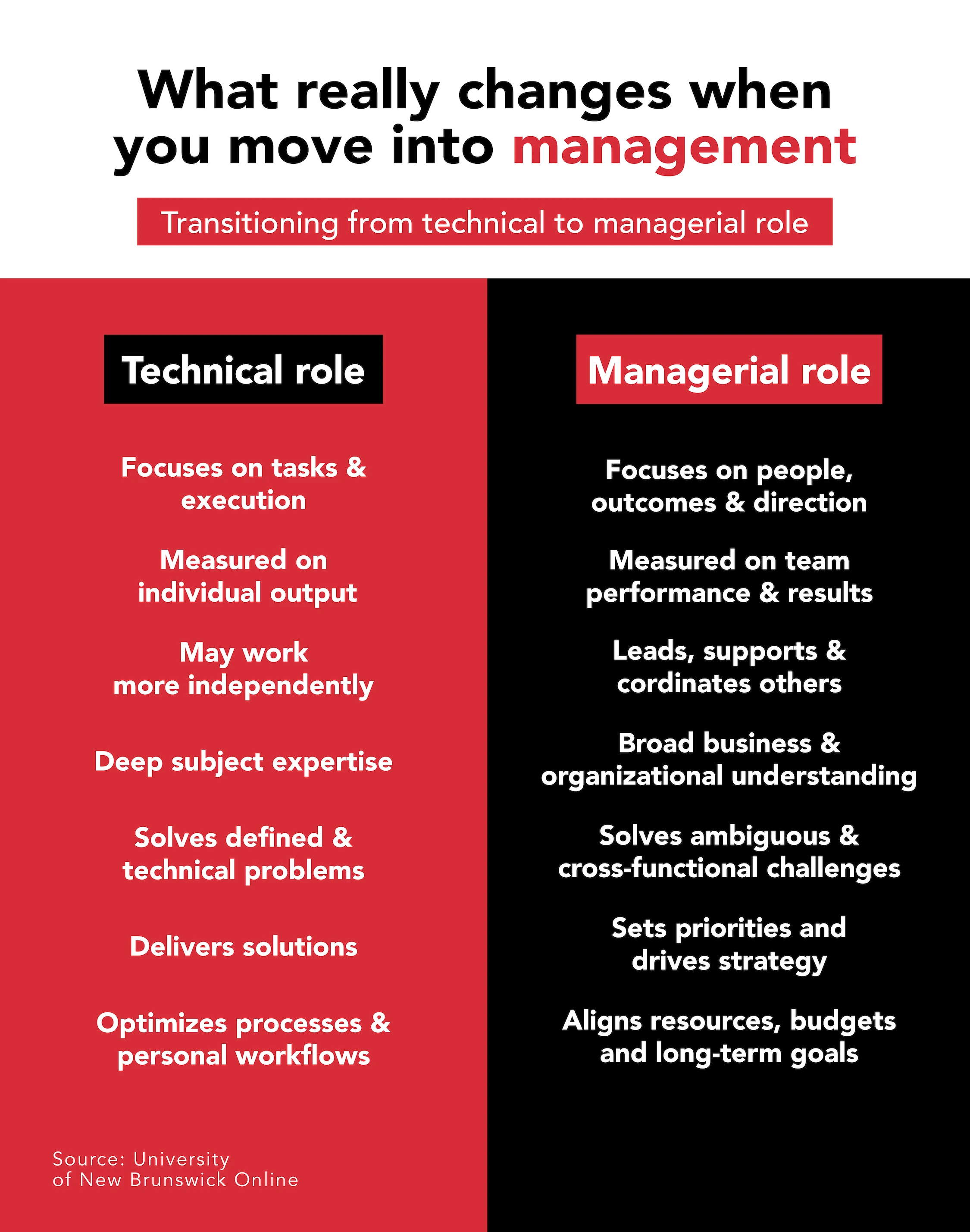
Excelling in a technical role doesn't automatically translate into success in a managerial role. There are new responsibilities to take on and different skill sets to develop to become an effective leader.
As a technical expert, you're often measured by output and efficiency, valued for depth of knowledge of technical details, focused on solving well-defined problems, and responsible for your own performance as an individual contributor.
A managerial role, however, changes the scope of responsibility.
You're still accountable for your own output, but also for outcomes achieved through your team members.
This often means:
- Shifting from task execution to strategic oversight
- Delegating instead of doing
- Making decisions with incomplete information
- Balancing budgets, timelines and team dynamics
- Leading people, not just projects
This mindset shift can feel uncomfortable at first. You may worry about losing your technical edge or about how you will be perceived by former peers.
Recognizing that this is a normal part of professional growth is the first step toward a confident transition.
Why self doubt is common when stepping into a managerial role
If you feel uncertain about stepping into a leadership position, you're hardly alone. Self-doubt is common during career transitions.
This hesitation often stems from a lack of formal exposure to broader business concepts.
You might have mastered your discipline, yet feel unprepared to navigate budgets, performance management or strategic planning.
A structured undergraduate education can help reduce this uncertainty.
Instead of learning through trial and error, you gain:
- Clear frameworks for informed decision-making
- A shared business language for setting expectations and giving feedback
- A deeper understanding of organizational systems
- Practical exposure to leadership scenarios
When you understand why certain strategies work and how organizations are structured, your confidence increases.
You begin to see yourself not only as a technical contributor, but as someone capable of guiding teams and influencing outcomes.
How a business management degree strengthens your leadership role readiness
In Canada, the demand for business and management skills remains strong.
Approximately 91% of business graduates are employed full-time within a year of graduation, and business, finance and administration occupations across industries account for a significant share of those employment numbers.
As such, a business management degree provides the foundational knowledge that many managers are expected to have, even when first stepping into a new position, but are rarely taught on the job.
Through it, you develop core competencies in:
- Finance and budgeting
- Operations management
- Organizational strategy
- Marketing fundamentals
- Business analytics
- Human resources management and conflict resolution
When you combine your technical background with a business management degree, you position yourself for roles that require both subject matter expertise and strategic leadership.
This broader understanding helps you see how decisions in one department affect the entire organization.
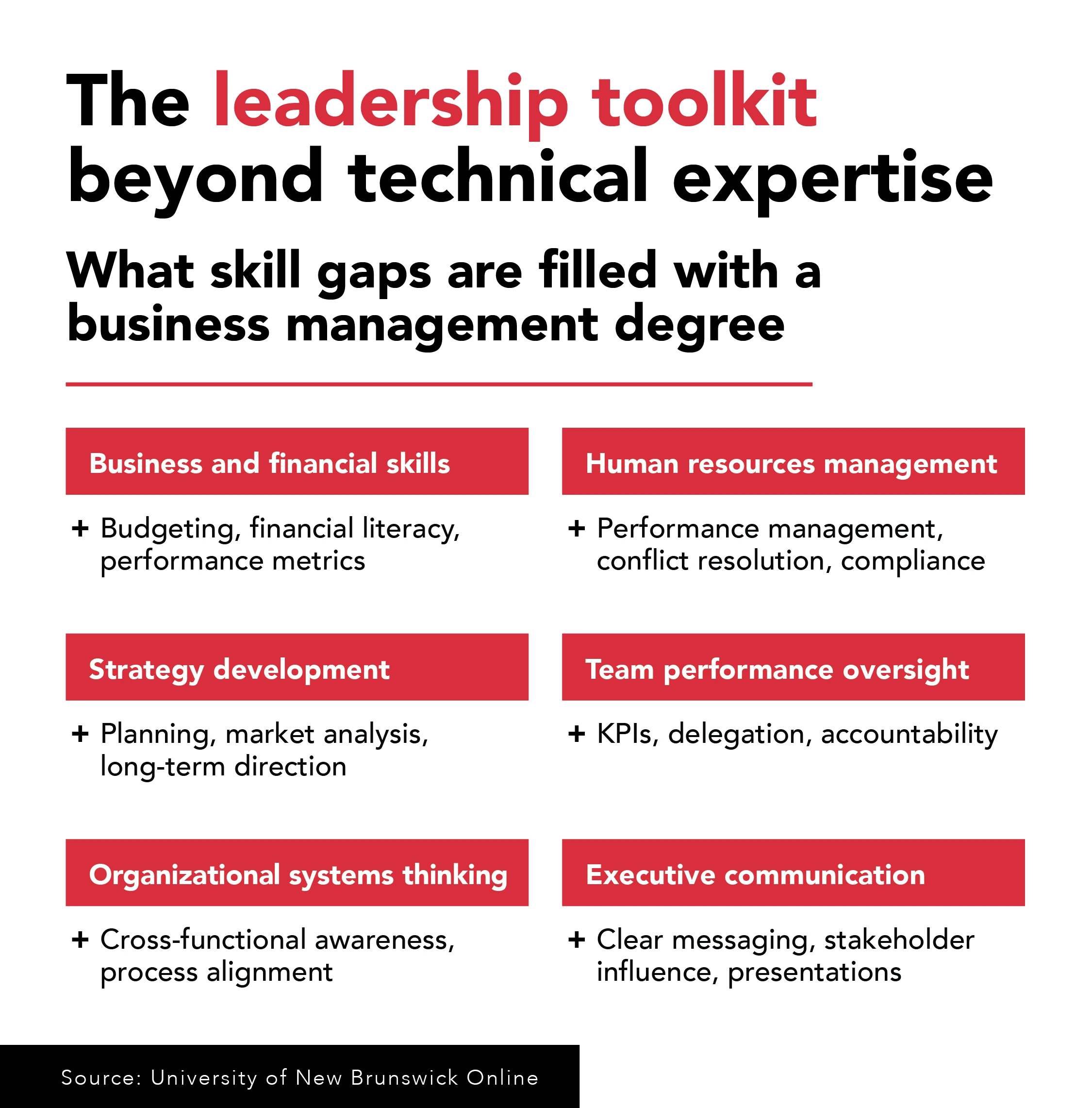
The leadership toolkit beyond technical expertise
Build human resources management skills for a leadership role
Human resources management is often where new managers feel least prepared, yet it's central to success in a leadership role. It's a continuous learning process that involves embracing growth opportunities.
Through a business management degree, you learn how to:
- Understand team dynamics and motivation
- Apply performance management frameworks
- Manage conflict professionally
- Navigate workplace policies and compliance
- Align individual performance with organizational goals
These skills are important when you move from being responsible for your own results to being accountable for a team’s performance.
Develop emotional intelligence for long-term leadership role success
The fear of being seen as an imposter can contribute to the emotional challenges new leaders face.
However, emotional intelligence is a skill developed over time and experience, just like technical proficiency, and effective leadership really does depend on it.
That's why a business management degree often integrates learning around:
- Self-awareness and leadership style
- Emotional regulation under pressure
- Active listening and empathy
- Reading team dynamics
- Addressing conflict constructively
As you develop emotional intelligence, you strengthen your ability to build trust, motivate others and lead through change.
Complete collaborative projects to prepare for a managerial role
Many business management programs emphasize collaborative, project-based learning. This simulates real-world leadership environments and helps learners gain the experience and confidence they need to succeed.
Through this collaborative approach, you often lead group projects with diverse personalities, practice delegation and accountability, present strategic recommendations and balance competing priorities within a team.
This experience mirrors the realities of a managerial role, which is especially valuable for new leaders.
Instead of focusing on individual tasks, you learn to manage group outcomes.
Aligning your business degree with your long-term career path
Before enrolling in a business program, it is helpful to clarify where you want your career path to lead.
Ask yourself:
- Do I want to manage a technical team?
- Am I interested in operations, consulting or general management?
- Do I see myself pursuing an MBA later?
- What industries align with my interests and experience?
Mapping your technical experience to business competencies can make your transition more strategic.
For example, if you work in IT, pairing your expertise with management and strategy skills can open doors to project management or information systems management roles.
By aligning your degree with your long-term goals, you can create a step-by-step pathway toward a leadership role.
Professional development strategies that accelerate your transition to a leadership role
The most successful transitions into leadership happen when structured education and intentional professional development work together.
Start by being strategic inside your current role.
Look for opportunities to take ownership of small initiatives, even if they are outside your formal job description. Volunteer to lead a meeting, coordinate a project timeline or present findings to senior stakeholders.
These experiences help you demonstrate readiness before you officially hold the title.
Seeking mentorship from those who have been in the same position is another powerful accelerator. Connecting with a current manager, director or executive gives you real-world insight into decision-making, accountability and team leadership.
Finally, track your progress intentionally.
Set measurable goals tied to leadership skills such as improving delegation, refining communication or strengthening conflict resolution.
When you combine academic management knowledge with practical action, you position yourself as a strong technical contributor and a capable, emerging leader ready for the next step.
Why an applied management degree can fast-track your managerial role transition
An applied business degree focuses on management fundamentals rather than broad theory.
This can be particularly valuable if you already hold a college diploma and want to build on your existing education.
Some second-entry programs are designed specifically for college diploma graduates who want to transition into leadership roles.
For example, the University of New Brunswick’s Online Bachelor of Applied Management is structured to help college diploma holders expand into management-focused coursework in a flexible format.
This applied approach allows you to immediately apply career-ready concepts to your workplace.
You also focus on leadership and strategy skills, complete your degree in a streamlined, hands-on format and can study online while maintaining full-time employment.
Measuring return on investment when pursuing a business degree for leadership advancement
When you're considering a business degree to move into a leadership role, return on investment matters. This is because you're investing time and tuition, long-term earning power, role eligibility and career flexibility.
From a demand perspective, Job Bank Canada continues to report steady hiring activity in management, business analyst and project management occupations across provinces.
Many of these roles explicitly require a bachelor’s as a minimum qualification, which means that earning a degree can expand the range of positions you are eligible to apply for.
Canadian data also shows a measurable earnings gap tied to education level.
According to Statistics Canada, individuals with a bachelor’s degree earn significantly higher median employment income than those with only a college diploma. About $58,900 annually, compared to $39,800 for a college diploma.
Salary growth over time further strengthens the case.
Glassdoor salary data for Canada shows that business bachelor’s degree holders with adequate professional experience often earn $75,000 or more, depending on industry and level of responsibility.
Redefine your career path with UNB’s Online Bachelor of Applied Management
If you are a college diploma graduate ready to step into a managerial role, UNB’s Online Bachelor of Applied Management can help get you there.
Our 100% online program is designed specifically for working professionals who want to transition into leadership while continuing their careers.
Request more information or apply today to begin building the strategic expertise and management capability that will define your next chapter.