

Key takeaways
- MBA hiring in the Maritimes is increasingly focused on practical skills, measurable results and the ability to lead change.
- Halifax, Moncton, Fredericton, Saint John and Charlottetown each have distinct sector strengths and employer networks.
- Strategic thinking, problem-solving, communication and growing AI fluency can help MBA grads stand out.
- A strong regional job search combines targeted applications with alumni outreach, industry involvement and local relationship-building.
- An MBA can strengthen your skills and credibility, but it works best when connected to a clear career goal.
MBA graduates in the Maritimes are entering a changing labour market shaped by retirements, digital innovations, regional growth and more selective hiring.
Location matters because hiring patterns in Halifax, Moncton, Saint John, Fredericton, Charlottetown and smaller communities can differ from those in larger Canadian markets.
This guide examines where business school graduates are needed and how you can leverage an MBA to build a stronger regional career strategy.
How is MBA hiring changing across the Maritimes?
MBA hiring is becoming more skill and results-focused, reflecting an employer’s immediate business needs.
Employers may value candidates who can combine broad business knowledge with local market awareness, sound judgement and the ability to put plans into action.
Atlantic Canada is also managing demographic pressure.
The Atlantic Canada Opportunities Agency has reported that an aging population and retirements are shrinking the available workforce, increasing the importance of skills development, workforce participation and talent attraction.
That creates opportunities for organizations that need people who can lead teams, improve operations, guide growth and make informed strategic decisions.
Which MBA jobs are most relevant in the Maritimes right now?
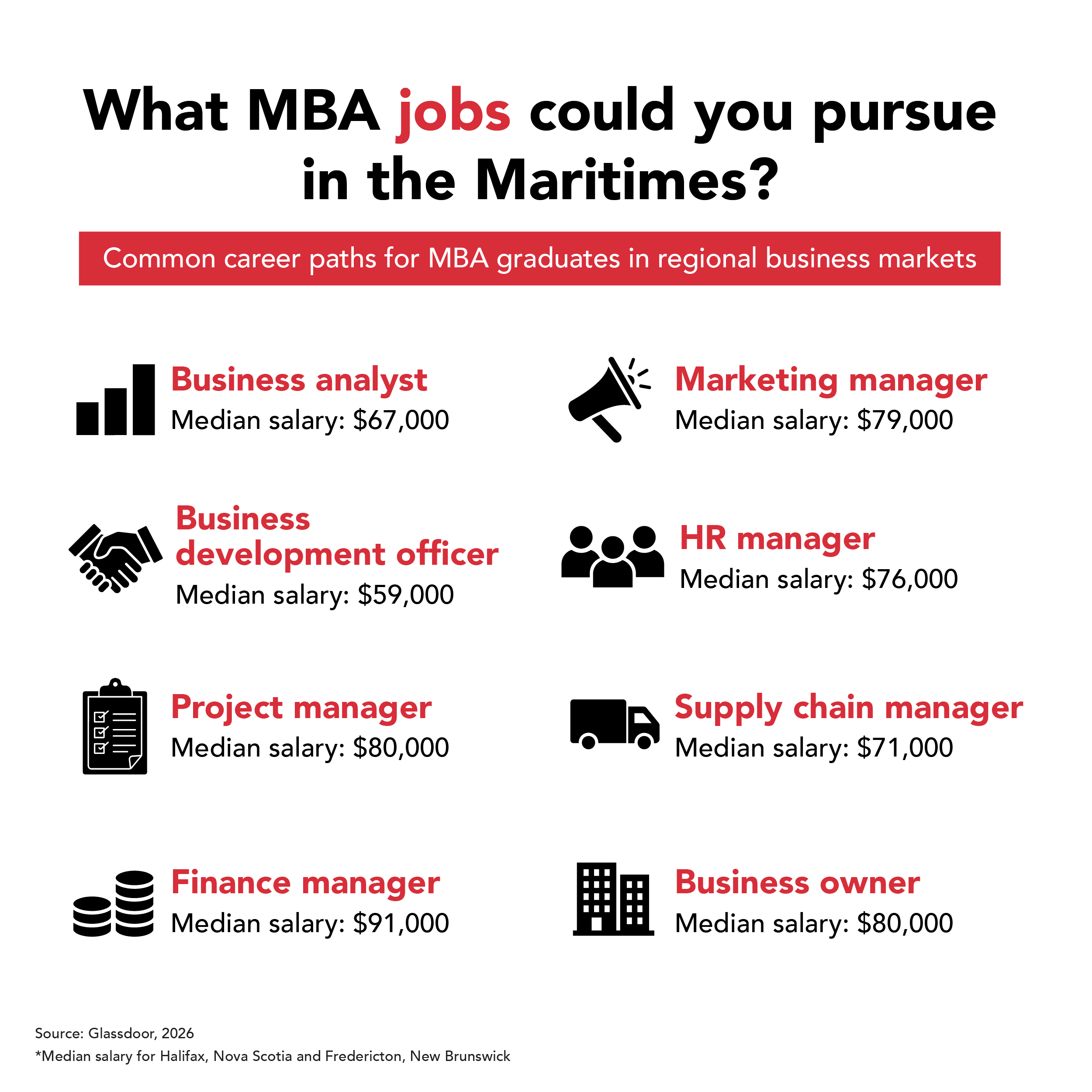
Relevant MBA jobs include management positions and broader business roles that reward graduate-level leadership, analytical and decision-making skills.
Salaries for MBA graduates in the Maritimes are generally competitive. Post-MBA salaries in Atlantic Canada generally range from $70,000 to $130,000+ depending on the industry.
You may find opportunities in:
- Finance, insurance and professional services
- Government, public administration and healthcare administration
- Technology, ICT, cybersecurity and analytics
- Ocean industries, energy and advanced manufacturing
- Tourism, hospitality, retail and consumer services
- Transportation, supply chain management and logistics
- Consulting, entrepreneurship and business development
Job titles can include business analyst, project manager, operations manager, financial manager, consultant, product manager, business development officer or director of strategy.
In smaller companies, one role may blend sales, operations, planning and leadership.
What does the Canadian job market mean for MBA grads in Atlantic Canada?
The Canadian MBA job market offers opportunities, but grads should expect competition and lead with adaptable skills rather than the credential alone.
Overall, hiring has remained relatively stable through 2025 and into early 2026.
However, Statistics Canada reported that job vacancies increased by 11,800, or 2.4%, in the first quarter of 2026. It was the first quarterly increase since Q2 2022.
The same report notes that there were five unemployed people with a bachelor’s degree or higher for every vacancy requiring that level of education, the highest ratio among the reported education groups.
Atlantic Canada also has smaller employer networks, stronger regional sector clusters and more opportunities that may be uncovered through referrals or direct outreach.
With this in mind, it's important to position yourself as someone who can solve a business problem; not just as someone who holds an MBA.
Where are Canadian companies in the Maritimes hiring business talent?
Canadian companies are hiring MBA talent in regions where industries are growing, modernizing or navigating complex operational demands.
Your search can reflect each market’s strengths:
- Halifax: Financial services, technology, oceans, life sciences and transportation. Halifax Partnership reports more than 1,300 finance, insurance and real estate firms and over 500 companies doing oceans-sector business in Nova Scotia.
- Moncton: Transportation, logistics, warehousing, business services and customer operations. The city reports 180 operating firms in transportation, logistics and warehousing.
- Fredericton: Cybersecurity, technology, public administration and entrepreneurship. Strong demand exists for MBA-level talent in government and public administration. The city describes Fredericton as a major centre for cybersecurity innovation and critical infrastructure protection.
- Saint John: Energy, advanced manufacturing, industrial operations and logistics. Local economic development efforts identify energy, exports and logistics as core strengths. There is increasing demand for MBAs in the healthcare sector. Healthcare jobs for MBA graduates increased by 26% recently.
- Charlottetown and PEI: Bioscience, tourism, public administration, food and small business. Supply chain talent is in particularly strong demand due to various economic activities. PEI’s bioscience sector includes more than 60 companies and over 2,100 employees.
Regional banks and insurance companies across the Maritimes continue to hire for management positions, with institutions like CIBC offering rotational leadership roles for MBA graduates.
What should international students know about MBA hiring in the Maritimes?
International MBA students should understand both employer expectations and the immigration or work rules that apply to their situation.
Priorities include confirming work authorization, understanding Canadian workplace communication, building local references and learning the hiring patterns of your target sector.
However, it's important to note that international students have equal job placement rates to domestic students and can also obtain a three-year work visa post-graduation.
The Atlantic Immigration Program also provides a permanent residence pathway for eligible skilled workers and international graduates who want to live in one of the four Atlantic provinces and have a qualifying offer from a designated employer.
Requirements can change, so check current Immigration, Refugees and Citizenship Canada guidance before making plans.
Your global experience can also be an advantage for employers pursuing exports, international partnerships or multicultural markets.
How can MBA programs prepare students for the job search?
MBA programs can prepare students by connecting classroom learning to the challenges and outcomes employers care about.
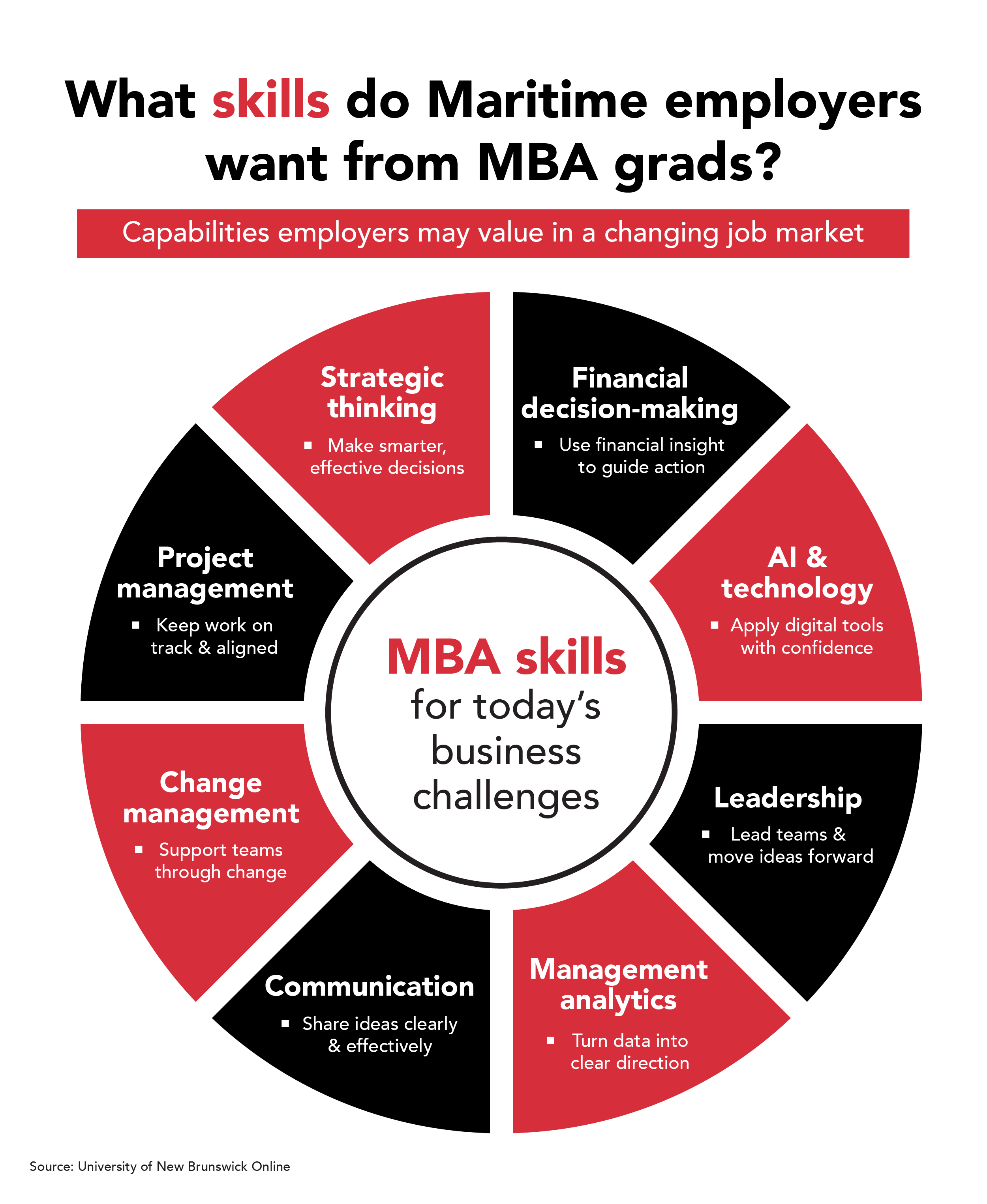
A strong program should help you build leadership confidence, strategic thinking, financial literacy, communication, data-informed decision-making and change management skills. It should also help you develop peer, faculty and alumni relationships.
GMAC’s 2025 employer research found that problem-solving and strategic thinking remain among the most valued skills when hiring graduate business talent. Experience in stakeholder engagement is also essential in the Maritime business community, as is familiarity with digital tools and data analysis.
In addition, the share of employers valuing skills with AI tools rose from 26% in 2024 to 31% in 2025.
This shows an upswing in major firms that are actively hiring MBAs for digital transformation and management consulting.
Why does business school reputation matter to MBA grads in regional hiring?
A business school's reputation can strengthen credibility when employers compare candidates in a competitive or relationship-driven market.
Look at accreditation, curriculum quality, faculty expertise, alumni reach, employer recognition and opportunities for practical learning.
AACSB accreditation is particularly useful because it provides an external signal of quality.
Reputation may help when a role doesn’t explicitly require an MBA but values advanced business training and leadership readiness.
How can MBA graduates make their job search stronger in the Maritimes?
MBA graduates can strengthen their search by combining focused applications with intentional regional networking.
Build a target list of employers, contact alumni, join chambers of commerce or sector associations and attend local business events.
On your resumé, translate coursework and projects into outcomes such as reduced costs, improved processes, stronger forecasts or a clearer growth plan. Apply for roles where MBA skills are useful even when “MBA” isn’t in the title.
Be ready to explain both why you’re qualified and why you want to build your career in the Maritimes.
What hiring trends should MBA grads watch next?
MBA grads should watch the trends reshaping how regional organizations operate and compete.
These include AI adoption, digital transformation, remote and hybrid work, small business succession, public-sector modernization, healthcare administration, energy transition, ocean technology, cybersecurity, ICT and export development.
GMAC’s research indicates that employers continue to value graduate business skills as technology and workplace models evolve.
Candidates who combine strategic thinking, communication, adaptability, AI awareness and regional knowledge may be better positioned for emerging roles.
Is an MBA a good choice for professionals targeting the Maritimes?
An MBA can be a good choice when it supports a defined career goal and fills a real gap in your skills, network or credibility.
It may fit if you want to move into senior leadership, pivot toward strategy, strengthen your finance and management analytics knowledge, make better data-informed decisions, grow within your organization or launch a business.
The most useful question isn’t, “Will an MBA guarantee a job?” It’s, “Will this MBA help me build the capabilities and relationships needed for the career growth I want?”
Take the next step with UNB’s Online MBA
Explore UNB’s 100% Online MBA, designed for working professionals who want to keep building their careers while studying.
The AACSB-accredited program includes 12 core courses and four electives and can be completed in eight terms, or about 2.67 years. You can specialize in Management Analytics or Venture Commercialization, Scaling and Investment.
Request more information about UNB’s online MBA or apply today.
Key terms
MBA graduate: A professional who has completed a Master of Business Administration and developed advanced knowledge in areas such as leadership, finance, strategy, operations and business decision-making.
Business development officer: A professional responsible for identifying growth opportunities, building partnerships, developing markets and helping an organization expand its revenue or reach.
Management analytics: The use of data, analytical tools and business judgement to support planning, improve performance and make informed organizational decisions.
Transferable skills: Skills such as communication, leadership, problem-solving and strategic thinking that can be applied across different roles, sectors and workplaces.
Regional labour market: The employment conditions, workforce needs, industry strengths and hiring patterns within a specific geographic area, such as the Maritime provinces.
Strategic management: The process of setting organizational goals, developing plans and making decisions that help a business achieve long-term success and competitive advantage.
Leadership development: The process of building the skills, knowledge and experience needed to effectively guide teams, manage change and support organizational growth.
Career advancement: The progression of an individual’s professional journey through opportunities such as promotions, expanded responsibilities, skill development and new career pathways.