

Key takeaways
- Management analytics careers combine data interpretation, AI literacy and business leadership.
- MBA graduates can help organizations translate analytical findings into practical decisions and measurable outcomes.
- Career paths include business intelligence, data science, AI strategy, operations, marketing and consulting.
- A strong Management Analytics MBA balances technical learning with strategy, finance, communication and leadership.
Artificial intelligence is becoming part of everyday business decision-making in Canada.
Statistics Canada reported that 19.2% of Canadian businesses had used AI to produce goods or deliver services during the 12 months leading up to the second quarter of 2026. Among those businesses, data analytics was the most commonly reported AI application at 36.6%.
This growth creates opportunities for analytics professionals who understand both data and the decisions behind it.
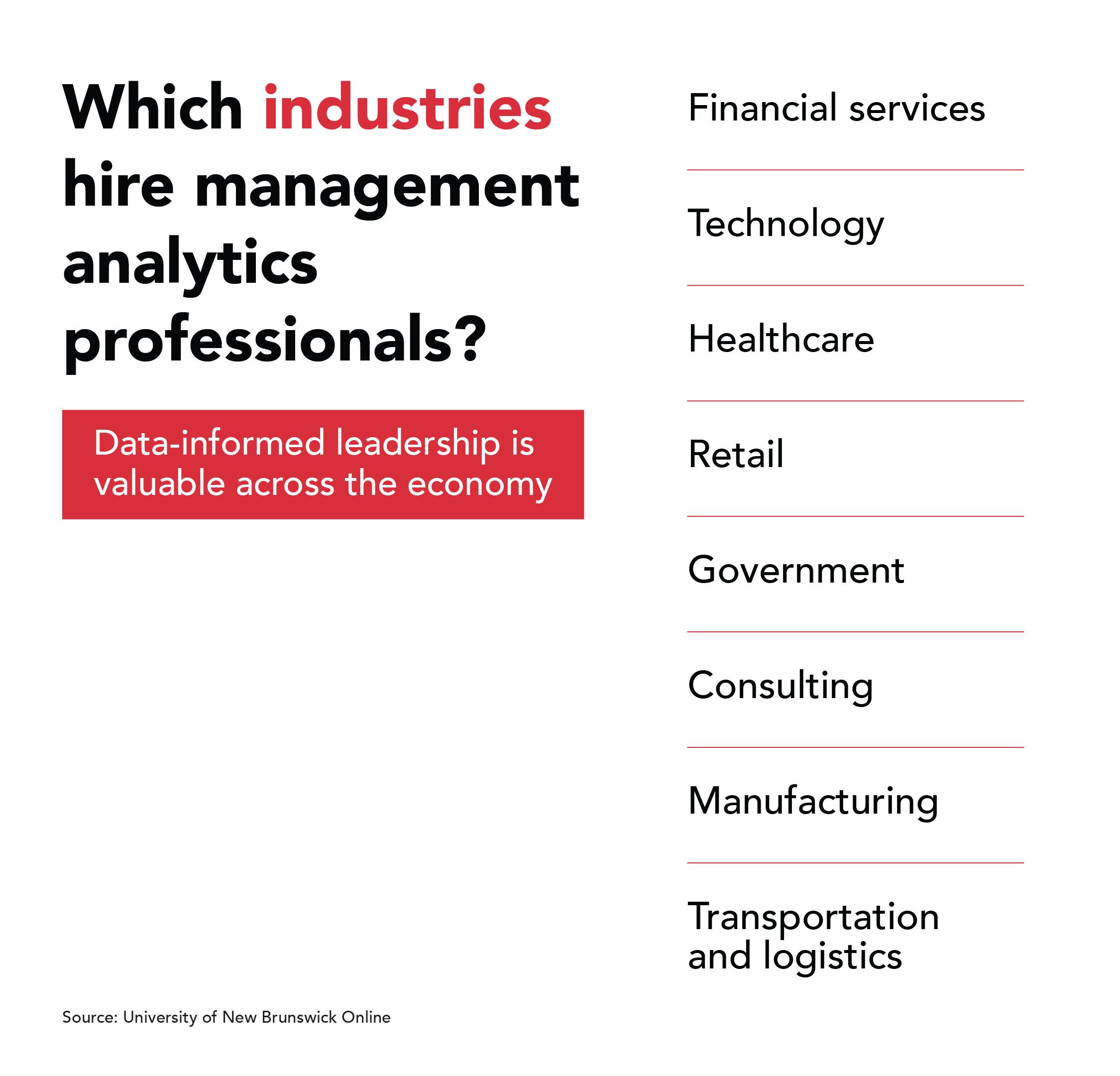
Management analytics careers remain valuable across sectors and industries. Below, we'll explain how AI is changing the field, which business skills employers value and 7 career paths that combine analytics with management responsibility.
How is AI changing management analytics careers?
AI and automation are changing management analytics careers by making forecasting, reporting, pattern recognition and decision support faster and more accessible. This requires ongoing learning and adaptation.
With this in mind, organizations need both technical AI specialists and business leaders who can guide responsible implementation.
For those considering an MBA, the opportunity lies in connecting executives, analysts, data scientists and technology teams.
You don’t necessarily need to build the algorithm, but you should understand its purpose, limitations and potential business value.
For example, managers are still responsible for deciding which problems are worth solving, whether an AI output can be trusted and how an insight should influence business priorities. They may also oversee data quality, privacy, governance, cybersecurity and human review.
What skills do MBA graduates need for careers in business analytics?
MBA graduates need analytical fluency, strategic judgement, communication skills and leadership capability to build careers in business analytics.
Employers value your ability to:
- Connect analytical findings and predictive analytics with organizational priorities
- Interpret complex data, dashboards, visualizations, forecasts and predictive models
- Assess AI use cases, risks, limitations and potential return on investment
- Present evidence clearly to technical and non-technical audiences
- Lead projects involving collaboration, governance and change management
- Understand and analyze SQL, Python and data visualization tools.
Technical familiarity helps you work confidently with specialists. Your management skills help ensure their work leads to a decision rather than another unused report.
How are data analytics, business analytics and data science different?
Data analytics, business analytics and data science differ in what they examine, the methods they use and the decisions they support.
Data analytics identifies raw data and trends, measures performance and helps explain what has happened within an organization.
Business analytics applies descriptive, predictive and prescriptive methods to business questions, such as how to reduce costs or improve retention.
Data science uses advanced statistics, machine learning and predictive modelling to identify patterns and produce automated recommendations.
Management analytics connects these capabilities with strategy, finance, operations and leadership.
As an MBA graduate, you may focus less on building complex algorithms and more on ensuring analytical work produces meaningful business outcomes.
How does business intelligence turn organizational data into better decisions?
Business intelligence turns organizational data into data-driven decisions by organizing information into dashboards, reports, visualizations and performance indicators.
Managers determine which metrics matter, how information should be presented and what teams should do with the findings. AI-enhanced business intelligence can also support forecasting, anomaly detection and faster exploration of large datasets.
Strong business intelligence leadership keeps reporting connected to strategic goals and prevents teams from collecting data without a clear question or action plan.
Which management analytics careers can MBA graduates pursue?
MBA graduates can pursue management analytics careers across emerging areas of AI strategy and transformation, such as healthcare, consulting and more.
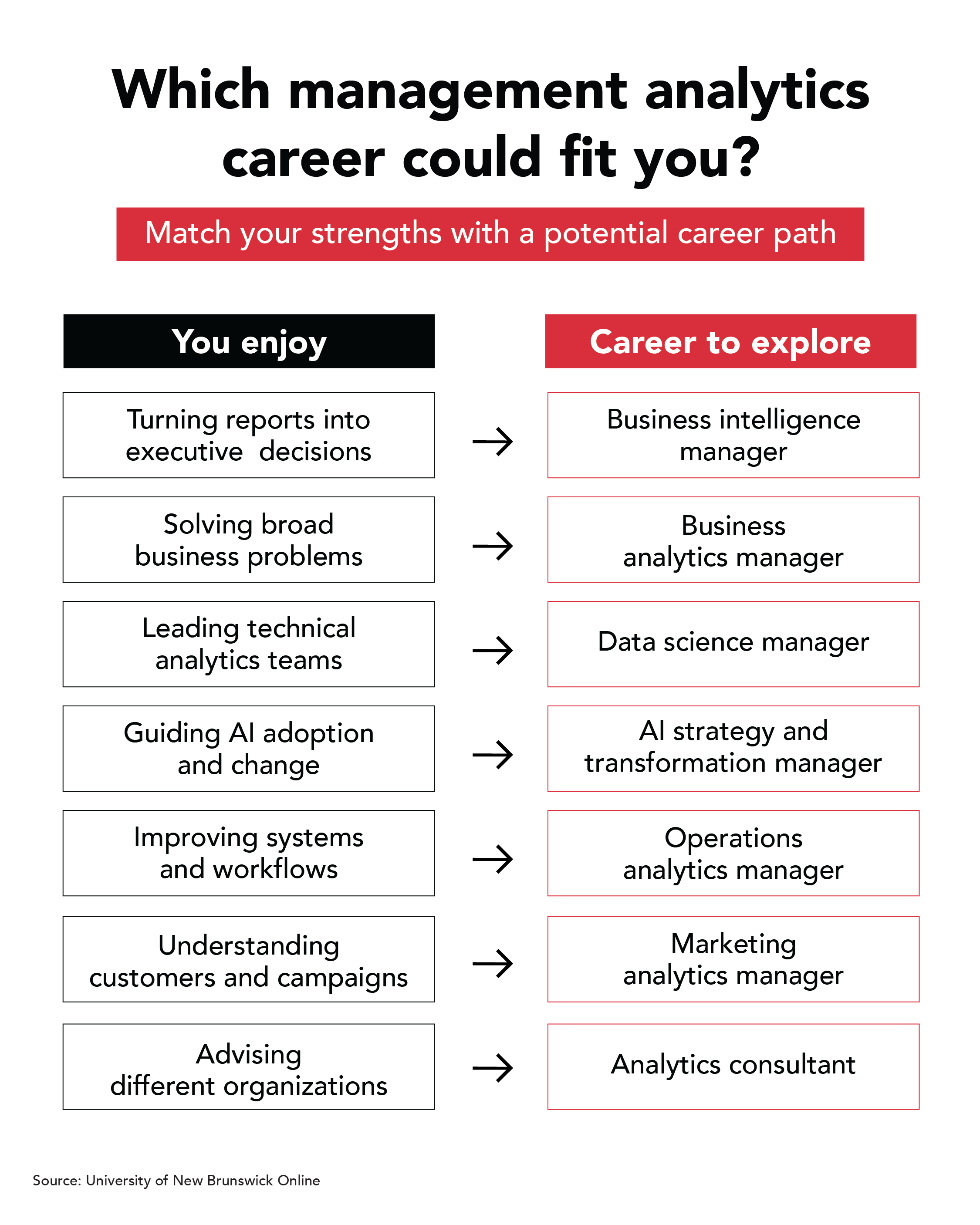
Below are 7 lucrative management analytics careers you may be interested in pursuing.
Business intelligence manager
Average base salary in Canada (2026): $103,000
A business intelligence manager leads the systems, processes and teams that help an organization understand its performance.
You may oversee dashboards, performance indicators, data quality standards and analysts.
You’ll also work with leaders to translate complex findings into recommendations connected to budgets, strategy and long-term goals.
Business analytics manager
Average base salary in Canada (2026): $90,000
Companies using data analytics gain a competitive advantage. A business analytics manager leads projects that answer questions about revenue, customers, risk and organizational performance.
You may identify problems suited to forecasting, modelling or scenario analysis, then coordinate analysts across departments.
The role also involves evaluating business value and presenting practical recommendations.
Data science manager
Average base salary in Canada (2026): $139,000
A data science manager guides teams that develop predictive models, machine learning applications and automated recommendations.
You’ll connect technical projects with organizational objectives while managing resources, timelines and executive communication.
You may also assess model performance, data quality, ethical concerns and implementation risks.
AI strategy and transformation manager
Average base salary in Canada (2026): $117,000
An AI strategy and transformation manager helps an organization identify, prioritize and implement valuable AI applications.
You may create adoption roadmaps, coordinate executives and technical teams and establish expectations for responsible use, human oversight and performance measurement.
Operations analytics manager
Average base salary in Canada (2026): $72,000
Operations analysts use data to optimize supply chains and resource utilization. An operations analytics manager uses forecasting and performance data to improve how an organization delivers products or services.
Your work may cover inventory, staffing, supply chains, procurement, production capacity or service quality. You’ll turn findings into process improvements while collaborating with finance, logistics, technology and frontline operations.
Marketing analytics manager
Average salary in Canada (2026): $105,000
A marketing analytics manager uses customer, campaign and revenue data to guide marketing decisions.
You may analyze customer behaviour, market trends, attribution and retention using segmentation, experimentation and predictive modelling.
You’ll also work with sales, product development, finance and digital marketing teams to allocate budgets based on evidence.
Analytics consultant
Average base salary in Canada (2026): $86,000
An analytics consultant helps organizations improve how they collect, interpret and apply data.
You may assess a client’s analytics capabilities, recommend tools and present findings through reports, workshops or executive presentations.
The role combines analytical thinking with commercial awareness, project management and stakeholder engagement.
What should you look for in a school of business when choosing an MBA in Management Analytics?
You should look for a school of business that balances analytical methods with leadership, strategy, finance and real-world decision-making.
A strong business analytics-focused MBA program should include:
- Applied learning involving dashboards, data warehouses, forecasting, regression models and data mining
- Projects and case studies that connect analytics with realistic organizational problems
- Faculty expertise and recognized AACSB accreditation
- Student support designed for working professionals
- Flexible delivery that lets you continue your career while studying
Review the curriculum rather than relying only on the program title.
What is the main opportunity in management analytics careers?
The main opportunity in management analytics is helping organizations make better decisions as data and AI become more influential.
Technology can identify patterns and accelerate analysis, but organizations still need leaders who can ask the right questions, evaluate risks and turn evidence into a comprehensive business strategy.
An MBA can help you build the strategic and organizational knowledge needed to lead that process. Combining analytical confidence with management judgement can prepare you for roles that connect technical work with actionable insights.
Build your analytics leadership career with UNB’s Online MBA
UNB’s Online MBA with a concentration in Management Analytics can help you turn information into strategy, decisions and measurable outcomes.
You can complete the MBA 100% online while learning from AACSB-accredited faculty. The program is structured across eight terms and offers January, May and September intakes. A GMAT waiver is available for qualified applicants.
Request program information to explore the curriculum, admission requirements and upcoming intakes or apply today to get started.
Key terms
Artificial intelligence: Technology that performs tasks associated with human intelligence, such as recognizing patterns, generating content or supporting decisions.
Big data: Extremely large and complex datasets that require advanced tools and methods to store, process and analyze effectively.
Business analytics: The use of data, statistical methods and analytical models to evaluate business performance, predict outcomes and support decision-making.
Business intelligence: Systems and processes that organize data into dashboards, reports and performance indicators.
Data visualization: The presentation of data through charts, dashboards and other visual formats.
Predictive modelling: The use of historical data and statistical methods to estimate future outcomes.
Responsible AI: The use of AI with governance, privacy protections, transparency, accountability and human oversight.