

Key takeaways
- A useful working range for many Canadian online MBA programs is roughly $20,000 to $90,000+, depending on the school, format and student status.
- Online MBA costs can include tuition, fees, textbooks, technology, application fees and occasional travel.
- Executive MBA programs often cost more because they may include coaching, residencies, premium networking and leadership development.
- The most affordable MBA isn’t always the best fit. Accreditation, flexibility, support and specialization value should also be considered.
According to Statistics Canada, average graduate program tuition in Canada averages $7,978 as of 2026. MBA programs, however, are typically priced higher because they're considered professional degrees.
The total cost of an online MBA generally falls between $20,000 and $90,000, with some executive programs potentially exceeding $120,000.
Below, we'll explore factors that influence online MBA costs, how to evaluate different programs and what to consider when assessing overall value beyond tuition.
What should students know about the cost of an online MBA?
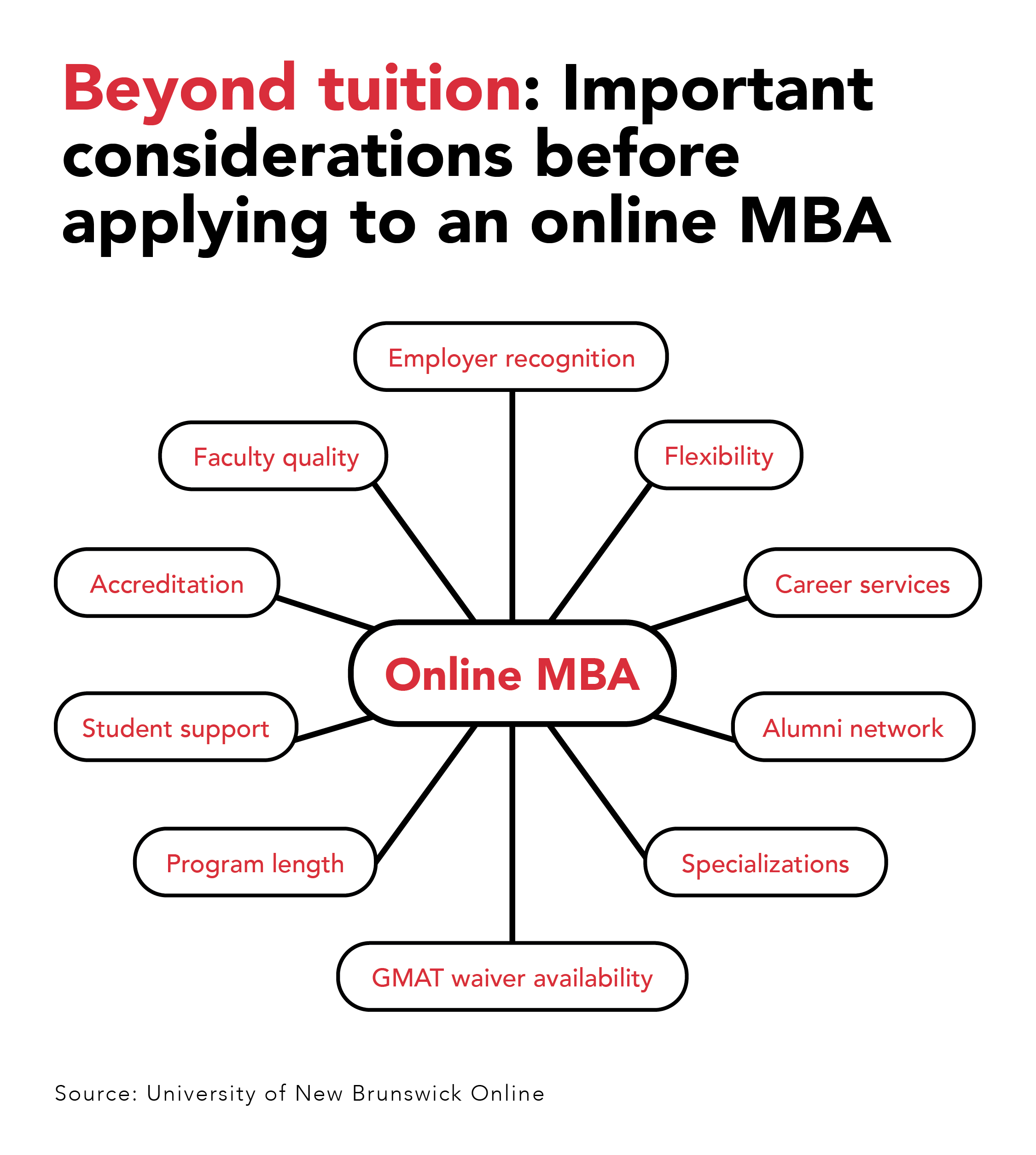
The cost of an online MBA usually includes more than tuition. When you compare online programs, consider the total investment, not just the amount on the main tuition page.
Common costs can include:
- Mandatory fees
- Course materials
- Textbooks
- Technology fees
- Application fees
- Travel costs for any in-person components
Some programs publish one total program fee. Others charge by course, term or credit.
Domestic, international and provincial residency can also affect the final cost. Many online MBA programs offer both full-time and part-time options, allowing students to choose a pace that fits their professional and personal commitments.
Why do business schools charge different prices for online MBA programs?
Business schools charge different prices for online MBAs because programs are built, supported and positioned differently.
For example, top-tier business schools often charge more due to their brand value, robust alumni networks and access to elite recruiters.
Pricing may depend on brand recognition, accreditation, faculty model, integrated capstone project, student support, cohort experience, career services, technology platform, specializations and domestic versus international pricing.
Some business schools also include learning materials, coaching, in-person sessions or travel-related elements in the program fee.
It's important to note that a lower-cost MBA can still offer strong value if it’s accredited, flexible and aligned with your goals. The key is to compare what the program helps you do next, not just what it costs today.
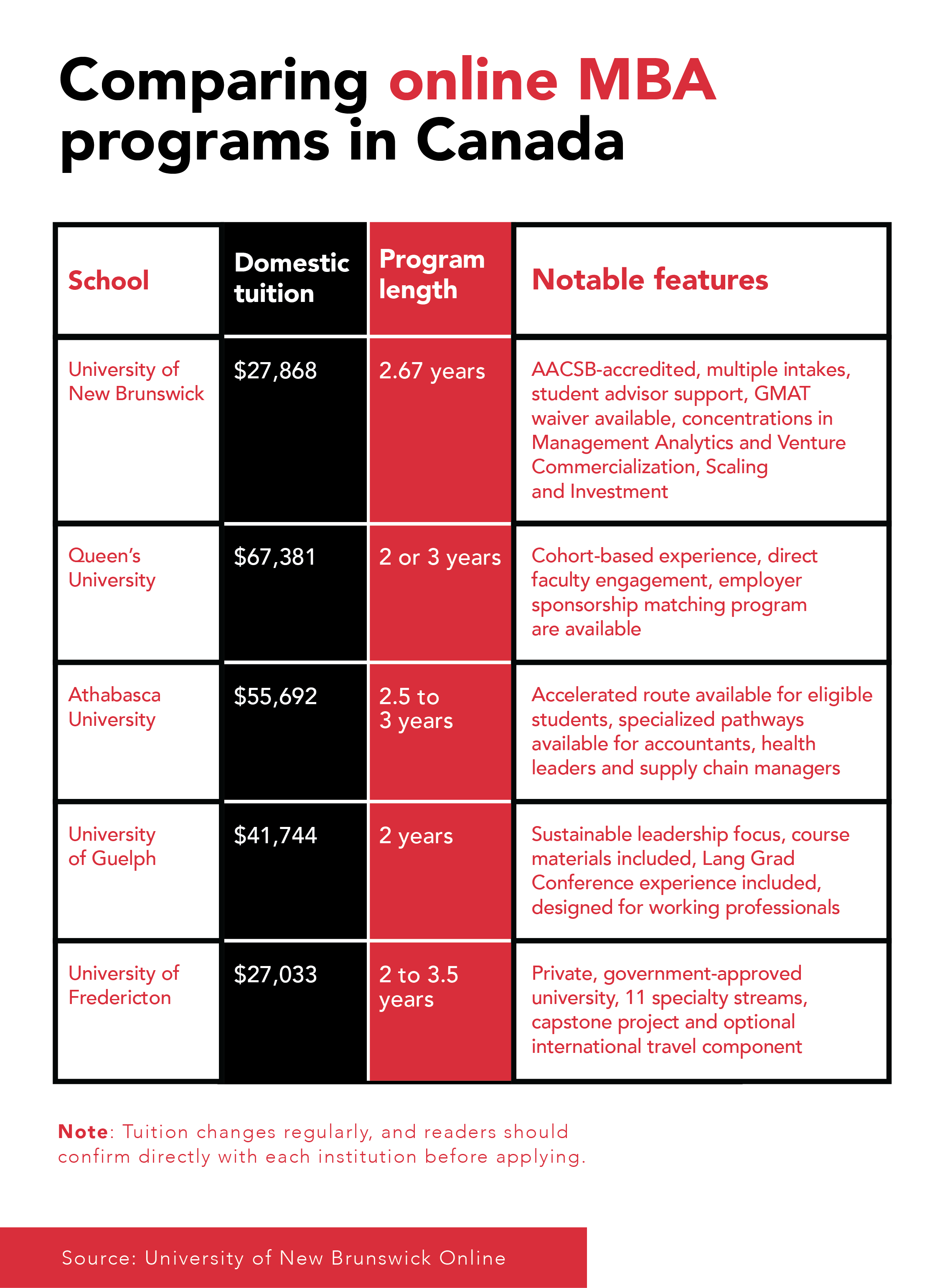
What are some of the best online MBA programs for affordability?
The best online MBA for affordability depends on your budget, career stage, learning style and long-term goals.
However, you shouldn’t separate affordability from quality.
Look at accreditation, course structure, support, reputation, specialization options and how well the program fits your career direction.
How can students use employer sponsorship to offset online MBA costs?
Employer sponsorship can reduce or even cover the cost of your online MBA if your employer sees a clear business benefit.
Before approaching your employer, prepare a simple business case that explains:
- How the MBA will strengthen your current performance
- How courses in financial management, management analytics, human resource management or digital marketing management connect to organizational needs
- How the online format can allow you to keep working while studying
- How your employer may benefit from stronger leadership, strategy, communication, decision-making and management skills
You can frame the conversation around retention, internal leadership development and immediate workplace application.
Instead of asking for funding only as a personal benefit, show how the organization can gain from the investment.
How does an Executive MBA compare in cost?
An Executive MBA is often more expensive because it’s typically designed for experienced leaders who want senior-level leadership development.
For example, Queen’s Smith School of Business lists total domestic program fees of $120,000 for its Executive MBA National Program.
Executive MBA programs may be a better fit for senior professionals seeking premium networking, coaching, residencies and executive development.
For many mid-career professionals, a traditional online MBA may offer a more cost-effective route to broader business administration leadership skills.
Does an accelerated MBA cost less?
An accelerated MBA can save time, but it doesn’t always reduce tuition.
For example, the University of Fredericton lists its Accelerated Master of Business Administration at $32,500, compared with its standard MBA at $27,033.
Accelerated formats may be designed for MBA students with prior business education or a relevant academic background. To decide whether acceleration is worth it, compare:
- Time to completion
- Core courses and course load
- Work-life balance
- Opportunity cost
- Career timeline
A faster MBA may help you move toward your next opportunity sooner, but only if the pace fits your life.
Do specializations like business analytics, human resource management, digital marketing, financial management or corporate finance change the cost?
Specialization costs depend on the school.
Some online MBA programs charge the same tuition regardless of specialization, while others may add costs for software, certifications, optional travel, external partner courses or applied projects.
Don’t compare the specialization price alone. Compare specialization value.
For example, UNB’s Online MBA offers concentrations in Management Analytics and Venture Commercialization, Scaling and Investment.
- Management Analytics may appeal to students interested in business analytics, data-informed decision-making and strategic problem-solving.
- Venture Commercialization, Scaling and Investment may suit students interested in entrepreneurship, innovation, investment readiness and business growth.
Alternative online MBA programs may offer specializations in areas such as finance, marketing, human resources, global management, supply chain management, management consulting, international business, project management or technology leadership.
Keep in mind that a specialization that aligns with your long-term objectives often provides greater long-term value than one with lower tuition alone.
What costs should students expect when an MBA is delivered online?
Online MBA formats are, on average, 25.6% cheaper than traditional on-campus programs due to the elimination of relocation, parking and commuting expenses.
For working professionals, the ability to keep earning while studying can be one of the biggest financial advantages.
Outside of tuition, the remaining costs may include:
- Textbooks
- Course materials
- Technology
- Application fees
- Occasional travel for residencies or opening sessions
It should be noted that blended programs that require on-campus immersions incur additional costs for facility use and programming.
How can students calculate the financial ROI of a Canadian online MBA?
Students should evaluate an online MBA as a long-term financial investment in their strategic leadership capabilities, not as a short-term cost-recovery calculation.
Instead of asking, “How quickly can I earn back the cost?”, ask, “How could this MBA support my earning potential, leadership opportunities and career stability over the next 5 to 10 years?”
Consider:
- Total program cost
- Potential salary growth over time
- Promotion opportunities
- Career mobility
- Employer reimbursement
- Time to completion
- Ability to keep working while studying
For example, if an online MBA costs around $28,000, you can compare that investment against potential salary growth, promotions, bonuses, employer reimbursement and expanded career opportunities over several years.
A lower-cost MBA may reduce upfront investment, but the stronger ROI may come from the program that best supports your long-term career path, professional confidence and ability to move into higher-level business administration roles.
Who is UNB’s Online MBA the right fit for?
UNB’s Online MBA is a strong fit for working professionals who want value, flexibility and credibility from an established Canadian university.
It may be a strong fit if you:
- Want an AACSB (Association to Advance Collegiate Schools of Business) accredited MBA from an established Canadian university
- Need a program that’s delivered online
- Want strong overall, competitive and comprehensive value
- Care about credibility, flexibility and long-term career relevance
- Want to continue working while earning your MBA
UNB is especially worth considering if you’re comparing affordability against reputation, accreditation and academic quality.
The program is 100% online, can be completed in 8 terms and offers a GMAT waiver for qualified applicants.
Find your fit in business administration leadership with UNB’s Online MBA
UNB’s Online MBA offers a flexible, competitively priced option from one of Canada’s most established universities.
With 100% online delivery, AACSB accreditation, multiple specializations and a GMAT waiver available for qualified applicants, our program is designed for working professionals who want value, flexibility and credibility.
Apply today, or request more info to review tuition, admission requirements, specialization options and upcoming start dates.
Key terms
Tuition: The base academic cost of the program.
Mandatory fees: Required non-tuition fees that may cover student services, technology, administration or other institutional costs.
Executive MBA: An MBA format typically designed for experienced managers, senior leaders or executives.
Accelerated MBA: A faster MBA pathway designed for students with prior business education or relevant academic preparation.
Blended MBA program: Involves a mix of online learning and occasional in-person sessions.
ROI: Return on investment, or the long-term value you gain relative to what you spend.
AACSB accreditation: A globally recognized business school accreditation that signals high standards in teaching, research and academic quality.
ACBSP accreditation: An accreditation focused on teaching excellence and student learning outcomes in business education.
Employer sponsorship: Financial support provided by an employer to help cover some or all MBA-related costs.
Specialization: A focused area of study within an MBA program, such as business analytics, finance, entrepreneurship or human resource leadership.
GMAT waiver: Permission to apply to an MBA program without submitting Graduate Management Admission Test (GMAT) scores if certain eligibility criteria are met.