

Key takeaways
- MBA admission requirements commonly include an undergraduate degree, professional experience and supporting application documents.
- You don’t need an undergraduate degree in business administration to pursue an MBA.
- GMAT and GRE requirements vary and some programs offer waivers for qualified applicants.
- English proficiency documentation may be required depending on your educational and language background.
- Meeting the minimum requirements is important, but a strong overall application can better demonstrate your readiness for MBA study.
MBA requirements in Canada typically assess your academic preparation, professional experience, English proficiency and overall application.
Online MBA programs generally maintain rigorous admission standards while giving working professionals greater flexibility in how they complete their education. That flexibility can make graduate business education more accessible without removing the need to demonstrate that you’re prepared for graduate-level study.
Understanding the requirements before applying can help you identify gaps early, strengthen your application and choose a program that fits your background.
What admission requirements are common for a Master of Business Administration in Canada?
Most Canadian MBA programs evaluate several aspects of your academic and professional background rather than relying on a single admissions criterion.
Common requirements can include:
- A recognized undergraduate degree and minimum GPA
- Relevant professional work experience
- Graduate Management Admission Test (GMAT) or Graduate Record Examination (GRE) scores
- University transcripts
- A professional résumé
- Academic or professional references
- A personal statement or statement of intent
- Proof of English-language proficiency when applicable
Exact requirements differ by institution. Before applying, review both the minimum eligibility criteria and any additional documentation your chosen program requires.
Do you need a four-year undergraduate degree to qualify for an MBA?
A four-year undergraduate degree from a recognized university or equivalent is a common route into an MBA.
Some institutions specify a particular cumulative grade point average or percentage average, while others may assess academic history alongside professional experience.
International applicants may also need to demonstrate that their previous education is equivalent to a recognized Canadian undergraduate degree.
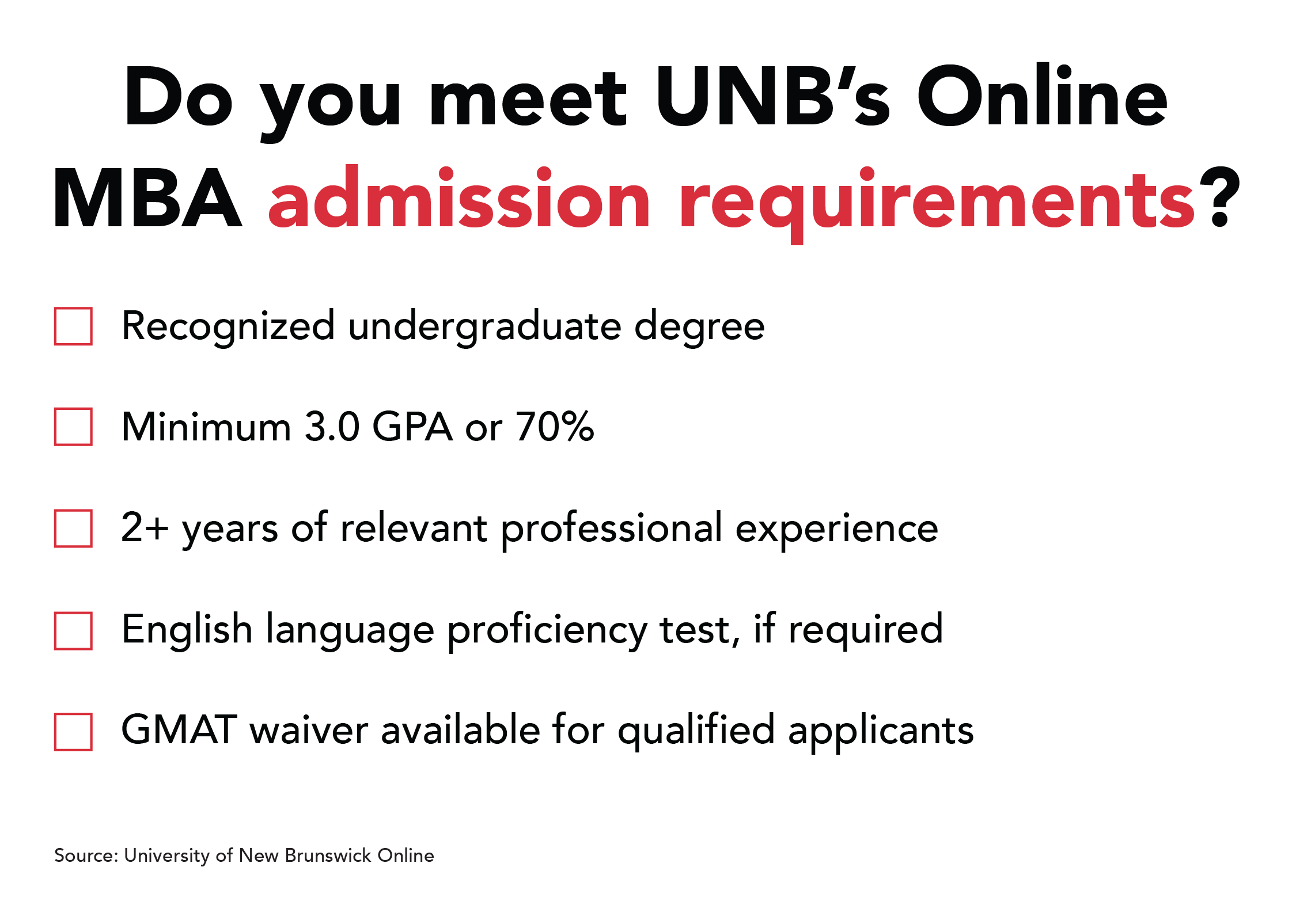
For example, UNB’s Online MBA requires a recognized undergraduate degree with a minimum 3.0 GPA on a 4.3 scale or 70%.
If you currently hold a college diploma rather than an undergraduate degree, you may need additional university-level education before applying to an MBA.
Does your undergraduate degree need to be in business administration?
No. An undergraduate degree in business administration isn’t a universal MBA requirement.
Professionals enter MBA programs from a wide range of backgrounds, including engineering, healthcare, technology, communications, sciences and the social sciences.
That variety can be valuable because students bring different industry knowledge and professional perspectives into business discussions.
However, requirements vary. Some specialized or accelerated programs may expect previous coursework in areas such as accounting, economics or statistics.
How much professional experience do MBA admission requirements typically include?
Many MBA programs expect applicants to have professional experience because the curriculum is designed to connect business concepts with real workplace situations.
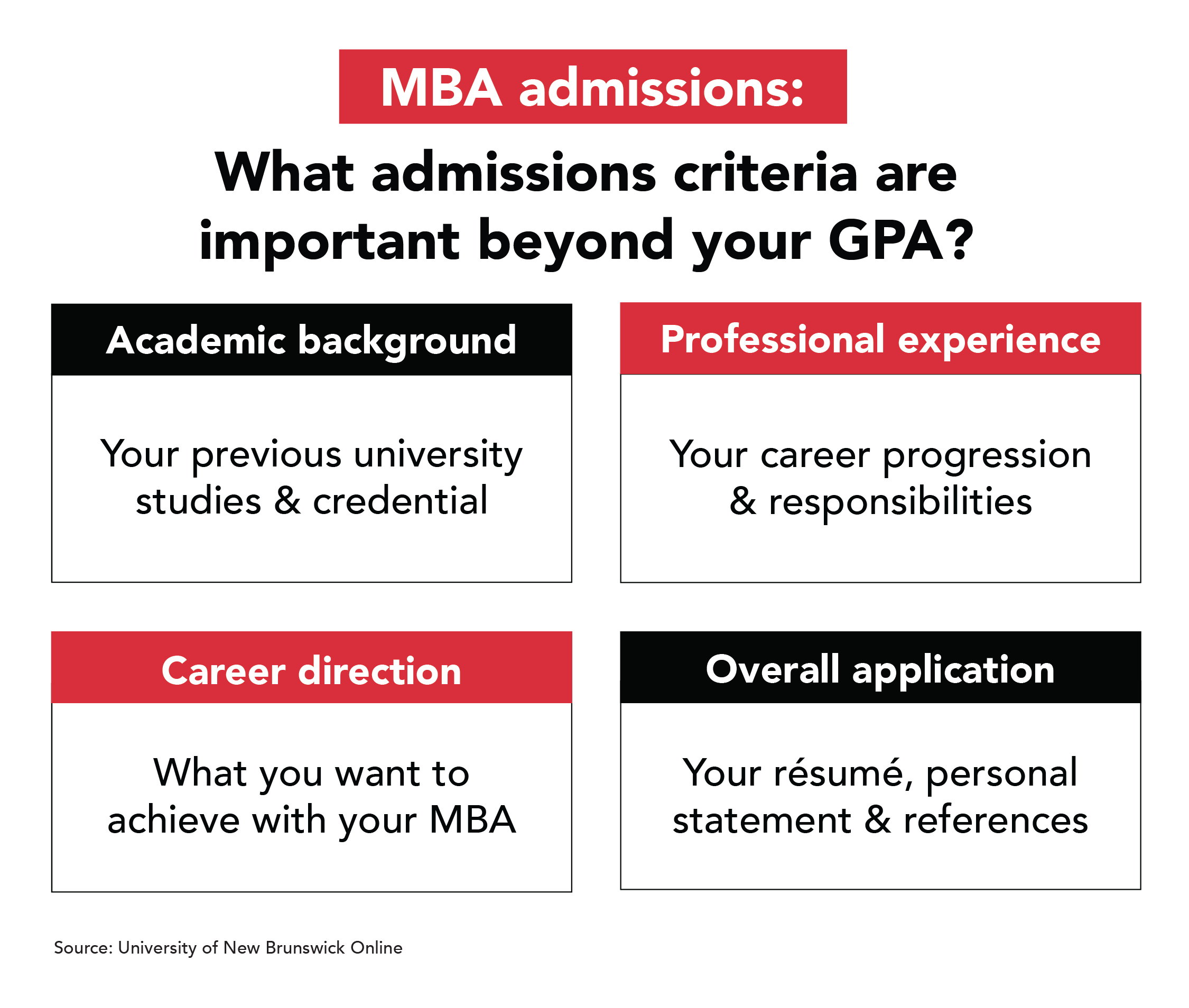
Two or more years of professional experience is a common benchmark, although requirements vary considerably. Some programs target early-career professionals while others are structured for applicants with several years of leadership or management experience.
What matters isn’t only how long you’ve worked. Your application can also demonstrate:
- Increasing levels of responsibility
- Leadership or project ownership
- Measurable accomplishments
- Cross-functional collaboration
- Decision-making experience
- Career progression
Exceptional candidates may be considered with less than two years of experience.
Your résumé and personal statement are opportunities to show how your work experience has prepared you to contribute to an MBA classroom.
Do you need a competitive GMAT score or can you qualify for a GMAT waiver?
You don’t necessarily need a GMAT score to apply for an MBA in Canada because testing policies vary by program.
Some schools continue to require the GMAT or GRE. Others make testing optional or offer waivers to applicants who demonstrate academic and professional readiness through other parts of their application.
For example, qualified applicants to UNB’s Online MBA may receive a GMAT waiver.
If you’re pursuing a waiver, remember that the rest of your application still matters. Your undergraduate performance, work history, references and career goals can all help demonstrate your ability to succeed in graduate business studies.
When do MBA applicants need to demonstrate English language proficiency?
English-language proficiency requirements usually apply when your previous education or language background doesn’t meet a university’s exemption criteria.
Canadian universities may accept tests such as IELTS Academic, TOEFL, PTE Academic or Duolingo English Test, although accepted tests and minimum scores vary.
Check both university-wide graduate admission policies and MBA-specific requirements. Some business programs may set different thresholds than the university as a whole.
If testing is required, plan ahead. You may need to submit your results before the admissions committee can consider your application complete.
What documents should you prepare for the MBA application process?
Most MBA applications require documents that help the admissions team understand both your academic history and your professional goals.
You may need:
- Résumé: Highlight relevant experience, career progression, responsibilities and accomplishments.
- Personal statement: Connect your career goals with your reasons for pursuing an MBA.
- Transcripts: Provide records from previous post-secondary institutions. A minimum B average is recommended for GPA.
- References: Choose two professional references who can speak to your academic abilities, professional performance or leadership potential.
- Test scores: Submit GMAT, GRE or English-language proficiency results if required.
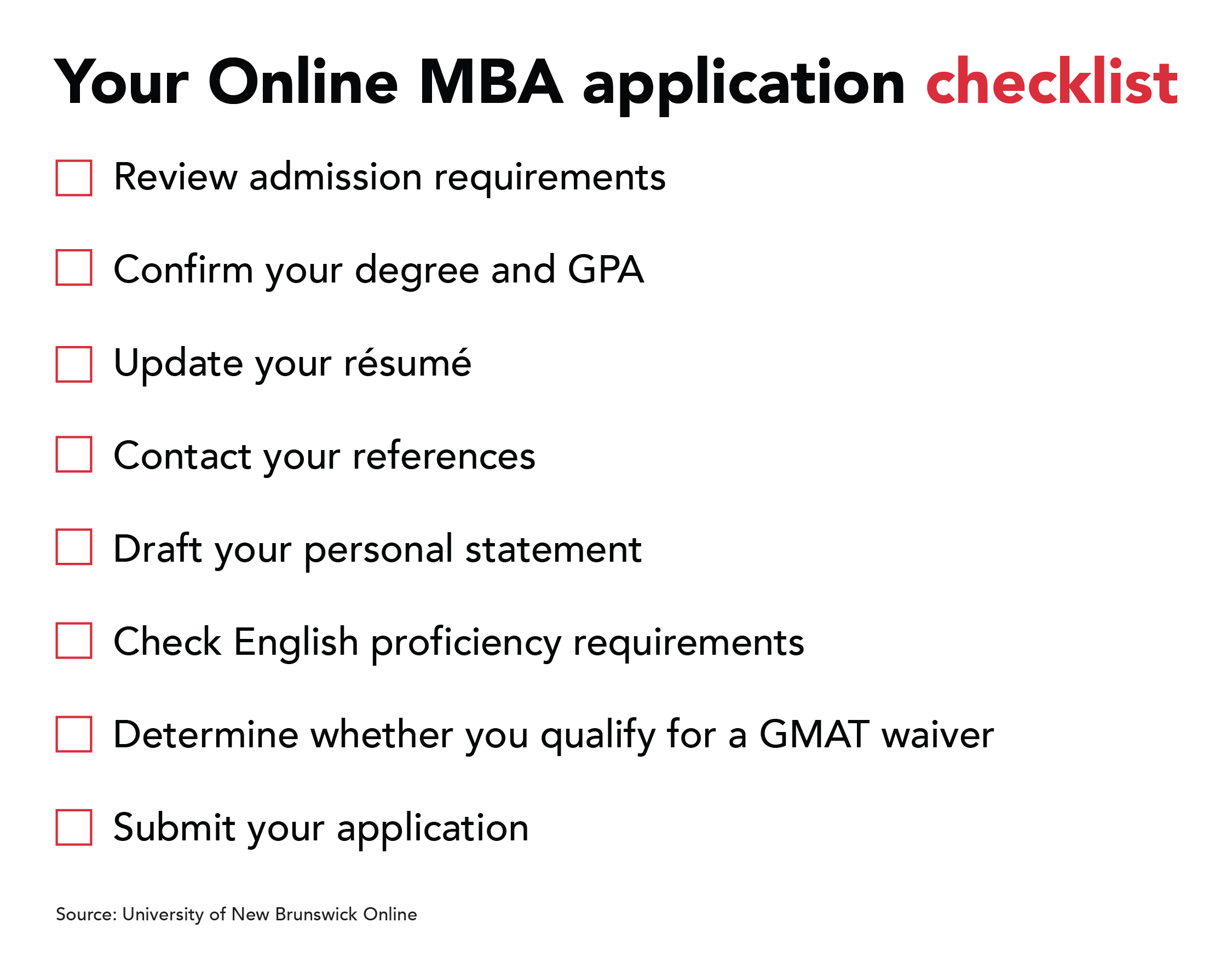
Requirements can differ significantly, so create a checklist for each program you’re considering rather than assuming every application will ask for the same materials.
What should you know before completing the MBA application form?
Review the admission requirements before starting your online application form so you know exactly what information and supporting documents you’ll need.
Gather accurate academic and employment dates to make sure your application aligns with your résumé and transcripts. Contact referees early and give them enough context about your goals so they can provide a useful recommendation.
Your personal statement deserves particular attention.
Rather than simply stating that you want an MBA, explain how your past experience connects with your future direction and what you hope to gain from graduate business education.
Finally, proofread everything before submitting.
How does the admission process work after you submit your application?
Once your application is complete, the admissions team reviews your academic history, professional experience and supporting materials.
Processing timelines vary by institution and may depend on the time of year. Some programs may also request clarification, additional documents or an admissions interview as part of the evaluation process.
During this period:
- Monitor your email and application portal
- Respond promptly to requests for additional information
- Make sure official transcripts or test scores are sent when required
- Review any next steps associated with an offer of admission
The final decision usually reflects the overall strength and completeness of your application rather than one individual factor.
When do you pay the application fee?
Most universities charge a non-refundable application fee when you submit your MBA application, although the amount varies.
The application fee is separate from tuition and may also be separate from any deposit required after admission.
Before applying, review the program’s current fee information so you understand what you’ll need to pay and when. International and domestic applicants may also be charged different amounts.
How do online MBA requirements compare with full-time MBA requirements?
Online delivery generally changes how you study, not whether you need to meet meaningful academic and professional standards.
Admissions criteria for online and campus-based MBAs can include many of the same elements, such as a bachelor's degree, professional experience, references and standardized testing where required.
The main difference is often flexibility after admission. A fully online MBA may let you keep working, study from another province and fit coursework around your existing responsibilities.
Employer perceptions of online graduate business education have also evolved. GMAC reported in 2025 that 55% of global employers surveyed agreed or strongly agreed that they value graduates of online or predominantly online programs equally to graduates of in-person programs.
When comparing programs, look at accreditation, admission requirements and delivery structure to determine what fits your career stage and schedule.
What can strengthen your MBA application if you only meet the minimum requirements?
Meeting the minimum requirements may make you eligible to apply, but the rest of your application can help demonstrate what you’ll bring to the program.
Focus on creating a clear, consistent picture of your experience and goals.
Your résumé can highlight promotions, expanded responsibilities, measurable results and leadership experience. Your personal statement can connect your previous experience with what you want to accomplish next.
Strong references can add specific examples of your abilities rather than simply confirming that you’ve worked or studied somewhere.
If you’re applying without a GMAT through a waiver, other indicators of readiness may take on greater importance. Make sure your academic record and professional achievements clearly show you can handle graduate-level work.
Take the next step with UNB’s Online MBA
UNB’s 100% Online MBA can be completed in eight terms and offers specializations in Management Analytics and Venture Commercialization, Scaling and Investment. Qualified applicants may also be eligible for a GMAT waiver.
You’ll study through an AACSB-accredited Faculty of Business while receiving personalized support from a dedicated student success advisor.
Request program information to explore the curriculum, admission requirements and upcoming intake. If you’re ready to take the next step, you can also begin your application today.
Key terms
Admission requirements: The academic, professional and documentation standards you must meet to be considered for admission.
GMAT: The Graduate Management Admission Test, which some MBA programs use to assess readiness for graduate business study.
GMAT waiver: Permission to apply without submitting GMAT scores when you meet a program’s eligibility criteria.
GPA: Grade point average, a numerical measure of your previous academic performance.
English-language proficiency: Evidence that you can successfully study in English, usually demonstrated through previous education or an approved language test.
Professional experience: Relevant work experience that demonstrates your career development, responsibilities and professional capabilities.
Personal statement: A written application component that explains your goals, motivation and reasons for pursuing an MBA.
Academic reference: A recommendation from someone who can speak to your academic ability and readiness for graduate-level study.